SrI: SrImathE SatakOpAya nama: SrImathE rAmAnujAya nama: SrImath varavaramunayE nama:
The extremely merciful periyavAchchAn piLLai has selected important SlOkams from SrI rAmAyaNam and provided detailed commentaries for them. This grantham is celebrated as SrI rAmAyaNa thaniSlOkam. puththUr swAmy has published it along with a beautiful thamizh commentary for it. We are enjoying the special meanings of the SlOkams in SrI rAmAyaNam from this grantham.
We are currently in yudhdha kANdam, also called abhayapradhAna sAram – vibhIshaNa SaraNAgathi.
nivEdhayatha mAm kshipram vibhIshaNam upasthitham I
sarva lOka SaraNyAya rAghavAya mahAthmanE II
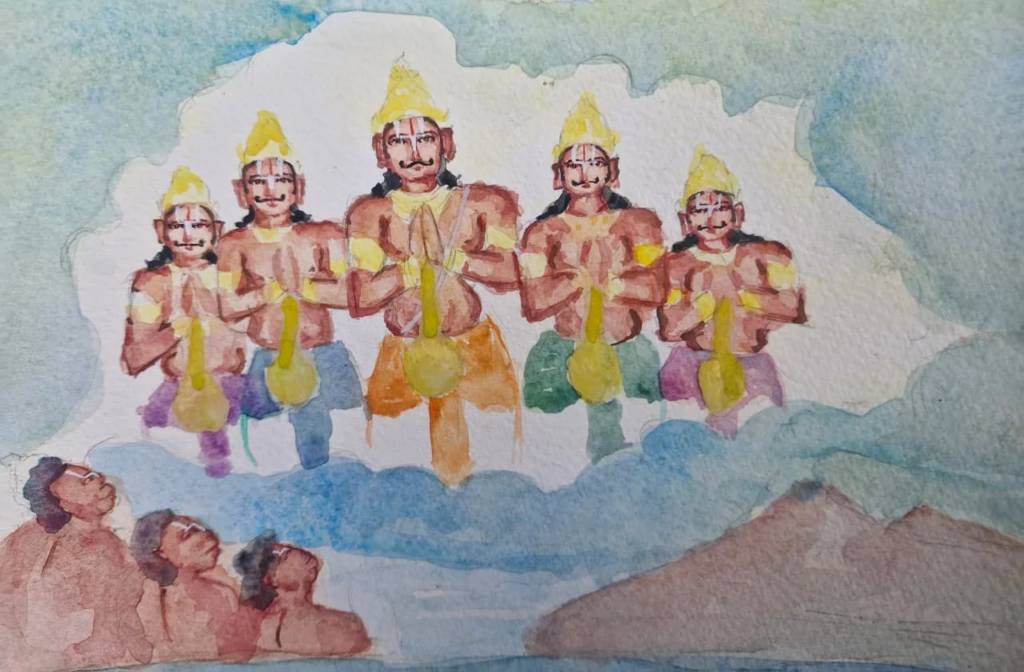
vibhIshaNAzhwAn prays to sugrIva mahArAja and others, “I have come to the mahAthmA, rAghavan, who is the ultimate refuge for all the worlds. Quickly inform him of my arrival”.
Before proceeding with the vyAkhyAnam, we express our gratitude to periyavAchchAn piLLai and puththUr swAmy, as well as to SrI u vE sArathy thOthAthri swAmy. This article is a translation of periyavAchchAn piLLai’s thaniSlOka vivaraNam with the support of SrI sArathy swAmy’s thamizh kAlakshEpam series.
In the previous article, we enjoyed the different explanations for mahAthmanE. In this article, we will enjoy the commentary continuing from the sixth interpretation for this word.
Notes from periyavAchchAn piLLai’s vyAkhyAnam
- rAghavAya mahAthmanE – rAghavan, one who is mahAthmA
[In the previous explanations, AthmA was referred to as dhEham, jIvan, and svabhAvam].
Using the definition of AthmA as paramAthmA, the following is explained.
emperumAn, SrimannArAyaNan, lowered himself by incarnating into the lineage of raghu. Yet, beyond all that, all his deeds identify him as paramAthmA. Even though he is the paramAthmA, as raghAvan, he is easily accessible (eLiyavan). And, though he remains beyond comprehension, through his mercy, his devotees can know him.
- thiruvAimozhi 1-3-4 “yArum Or nilaimaiyan ena aRivariya emperumAn” (emperumAn is having a state that is not understandable by those who are not devoted to him).
- thiruvAimozhi 1-3-4 “yArum Or nilaimaiyan ena aRiveLiya emperumAn” (emperumAn is having a state that is understandable by the devotees even though they may be very ignorant).
Furthermore, the vEdhams also reveal the divine incarnations of emperumAn.
- thaiththirIya upanishadh nArAyaNa valli 1-12 “sam bAhubhyAm namathi sam pathathrai:” “dhyAvApruthivI janayan dhEva Eka:” (The nonpareil supreme entity who creates all the worlds, incarnates with hands and feet [as humans] in this world).
- purushasUktham ““vEdhAhamEtham – purusham mahAntham” (The vEdham says: I understand this supreme entity as mahAthmA).
These vEdhic percepts (pramANams) also corroborate that this easily accessible entity (saulabhyam) is indeed the supreme entity. The vaidhika purushan, viSwAmithra bhagavAn has also said the same. [He is a great sage, who has performed severe austerities]. Therefore, it goes without saying that an erudite scholar like him knows SrI rAma is mahAthmA! However, even thArA, a woman orphaned by husband, realised perumAL’s greatness! Don’t you, as men, know it?
- SrI rAmAyaNam bAla kANdam 19-14 “rAmam mahAthmAnam vEdhmi” (I am aware that SrI rAma is the mahAthmA [sublime soul]).
- SrI rAmAyaNam kishkindhA kANdam 24-28 “ayam sa kAkuthstha ithi prajagyE” (She recognised/realised that he (SrI rAma) is that descendant of king kAkuthsthan).
- SrI rAmAyaNam kishkindhA kANdam 24-31 “thvamapramEyaScha” (You are beyond comprehension).
vibhIshaNAzhwAn asks, “The vEdha purushan (vEdham itself), vaidhika purushan (sage viSwAmithra), and even a woman grieving the loss of her husband (thArA) have all realised he is mahAthmA, don’t you know it”?
- rAghavAya mahAthmanE –
Using the definition of AthmA as sun and fire, the following is explained.
- SrI rAmAyaNam sundhara kANdam 17-18 “rAmadhivAkara: I SathrurakshOmayam thOyamupaSOsham nayishyathi” (pirAtti says: SrI rAma, the sun, possesses arrays of arrows as his rays. He will vanquish the rAkshasa enemies just as the sun’s rays completely desiccate water).
- SrI rAmAyaNam ayOdhyA kANdam 99-26 “abhitha: pAvakOpam” (bharathAzhwAn says that he saw SrI rAma resembling a fire).
- thirunedunthANdakam 14 “muLaikkadhirai” (He, who is like a young sun).
- thiruppAvai 25 “kanjan vayiRRil neruppenna ninRa nedumAlE” (Oh, you who loves his devotees! you bothered kamsan like a ‘fire’ in his stomach).
Thus, this is interpreted as vibhIshaNAzhwAn reassuring the others that they need not fear any harm to perumAL, as he is like the sun and fire and will incinerate his enemies.
- rAghavAya mahAthmanE –
Using the definition of AthmA as intellect, the following is explained.
vibhIshaNAzhwAn says, “You are monkeys; you move around the outer SAkhAs (branches), but you do not examine the inner meanings of the SAkhAs – the branches of the vEdham”.
- yajus samhithA 6-5-29 “dhEvA vai thvashtAramajighAmsan I sa pathnI: prApadhyatha I tham na prathiprAyachchan I thasmAdhapi vadhyam prapannam na prathiprayachchanthi I” (The dhEvas wanted to kill thvashta; but he took refuge with their wives; they did not reveal him to the dhEvas. Therefore, it is understood that those who surrender should not be exposed, even when they are worthy of being killed).
- SrI rAmAyaNam yudhdha kANdam 18-28 “SaraNAgatha: ari: prANAn parithyajya rakshithavya: kruthAthmaNA” (Whether or not a surrendered enemy is fearful or fearless, he is worthy of being protected; a righteous person should protect him even if it amounts to sacrificing his own life).
As such, vibhIshaNAzhwAn requests sugrIva mahArAja and others, “perumAL is a scholar of vEdham and vaidhika verses; he is a savant who possesses the wisdom that an enemy seeking refuge must be protected, even at the cost of one’s own life. Inform him”.
- rAghavAya mahAthmanE – a destroyer of enemies and a comforter of the surrendered
Using the definition of AthmA as air (vAtham), the following is explained.
- vishNu purANam 1-14-31 “thasmai vAthAthmanE nama:” (I bow to him, the one who is vAthasvarUpi [form of wind]).
- thiruvAimozhi 6-9-1 “kAlAy” (having form of air).
Accordingly, it can be interpreted as – perumAL (rAghavAya) annihilates the enemies like the whirlwind (mahAthmanE), but to the surrendered he bestows happiness like a gentle, cool breeze (mahAthmanE).
- vaijayanthI dhvyakshara kANdam 1-6 “AthmA jIvE dhruthau dhEhE svabhAvE paramAthmani, yathnE arkkE akhnau mathau vAthE” (The word AthmA is used in the context of jIvAthmA, resoluteness, physical form, svabhAvam (inherent nature), paramAthmA, endeavour, sun, fire, intellect, air).
Thus, through this, it is conveyed that all the above entities emphasised SrI rAma’s SaraNyathvam (quality of being a refuge).
sugrIva mahArAja and others said to vibhIshaNAzhwAn, “Oh, nicely said! It was you who explained his glory as mahAthmanE. Accordingly, he is opulent and superior, while we are nobody – like comparing a mountain to a pebble. How then can we even approach him and hold onto him as our upAyam”?
- nAchchiyAr thirumozhi 10-10 “nAgaNai misai nambarar selvar periyar siRumAnidavar nAm” (Our perumAL, one who is reclining on the mattress of AdhiSEshan, is opulent, superior to everyone else; on the other hand, we are lowly human entities).
- thiruvAimozhi 5-1-7 “ammAn Azhip pirAn avan evvidaththAn yAn Ar” (Where is the natural lord – the great benefactor with the divine hand and divine chakra who lets his devotees enjoy him – standing? And what is the capacity of the lowly me)?
- sarvalOkaSaraNyAya – ultimate protector of everyone. Is there anyone who is an unworthy recipient of perumAL’s SaraNyathvam quality?
- sarvalOkaSaraNyAya
- SrI rAmAyaNam sundhara kANdam 38-56 “kausalyA lOkabharthAram sushuvE yam manasvinI I tham mamArthE sukham pruchcha SirasA chApivAdhaya” (sIthAp pirAtti tells thiruvadi, “Enquire about his well-being and, on my behalf, bow down with your head to the lord of the universe, whom the noble-minded kausalyAp pirAtti gave birth to).
vibhIshaNAzhwAn’s purport was the same as pirAtti – ‘perumAL is the lord of everyone in the universe, and I too, am part of that universe’.
- thiruviruththam 33 “agal visumbum nilanum iruLAr vinai kedachchengOl nadAvudhir IngOr peNpAl poruLO ennum igazhvO ivaRRin puRaththAL enReNNO” (You are ruling both the expansive sky and this earth such that sins which are caused by ignorance run away, through your divine disc. Regarding the matter of protecting this one girl, in this material realm – is it contemptuousness? Or is it because you think she is outside the area of your kingdom? What is your divine opinion)? As such, vibhIshaNAzhwAn’s thoughts were similar to parANkuSa nAyaki.
- sarvalOkaSaraNyAya
- thiruvAimozhi 3-3-4 “nIsanEn niRai onRum ilEn en kaN pAsam vaiththa paranjudarch chOdhikkE” (The one in a fully radiant form, acquired his perfect radiance, by placing an infinite attachment towards me – who is a downtrodden and having no completeness).
emperumAn bestows his mercy until the very end, in spite of endless offences, therefore, vibhIshaNAzhwAn says, “Inform perumAL, who is glorified because of that infallible determination”.
- sarvalOkaSaraNyAya
- “sarvalOkaika vIrasya dhaSakaNtakuladhvisha:” (Throughout all the worlds, he stands alone as the supreme warrior, the ultimate adversary to rAvaNa’s clan).
- “bhUrbhuvas suvar mahar janas thapassathyam” (bhU lOkam (the earth), bhuvar lOkam, suvar lOkam (heavenly planet), mahar lOkam, janO lOkam, thapO lOkam, sathya lOkam).
Thus, to all the entities in all of these worlds, he is the ultimate refuge.
- sarvalOkaSaraNyAya
emperumAn is the ultimate refuge [not only for the seven worlds above but also] for all the worlds below the earth – athala, vithala, suthala, thalAthala, mahAthala, rasAthala, pAthAla – encompassing everything without exception. vibhIshaNAzhwAn says, “He is the only protector of all the fourteen worlds. Would he not protect me”?
- sarvalOkaSaraNyAya
[Note from kAlakshEpam: While elaborating on the protectorship of emperumAn, he first established that emperumAn is the ultimate protector of the seven worlds. He then stated that emperumAn is the sole refuge for all the fourteen worlds. Through this interpretation, he explains that perumAL is the rakshakan (protector) of both realms (ubhaya vibhUthi) – leela vibhUthi (material realm with infinite universes) and nithya vibhUthi (eternal realm that is many times larger than the material realm)].
[These are AzhwAr’s words when he sends the birds as his messengers to emperumAn – ‘If you describe my situation and bring his response to me, I will grant you a place for you wherever you desire, either in this material realm or in paramapadham’].
- thiruvAimozhi 6-8-1 “ponnulagALeerO? bhuvani muzhudhALeerO?” (Would you rule the eternally desirable paramapadham? Would you rule the entire material realm highlighted by the earth)?
[ANdAL nAchchiyAr describes (in thiruvaranga pAsuram) that emperumAn is the lord of both the vibhUthis].
- nAchchiyAr thirumozhi 11-3 “pongOdham sUzhndha buvaniyum viNNulagum angAdhum sOrAmE ALginRa emperumAn” (My lord, he controls this world surrounded by ocean with agitating waves and paramapadham, without any shortcoming).
- muNdaka upanishad 2-2-10 “hiraNmayE parE lOkE” (In the highest golden realm, the blemishless brahmam (emperumAn, the supreme entity) resides).
[The following is the question asked by vAlmeeki bhagavAn to sage nAradha in the beginning of SrI rAmAyaNam]
- SrI rAmAyaNam bAla kANdam 1-2 “asmin sAmpratham lOkE” (Who in this world, at this present time, possesses all the auspicious qualities? Who is the bravest?..).
As stated through all these pramANams, sarvalOkaSaraNyAya could also be interpreted as perumAL, who is the protector of ubhaya vibhUthis.
- sarvalOkaSaraNyAya
When it is said, “manchA: krOSanthi” (The beds are crying), it implies that the people on the beds are crying. Using this lakshaNam (implied meaning), sarvalOkam (all the worlds) refers to the people within those worlds. Therefore, sarvalOkaSaraNyAya means ‘He is the protector of all the people in all the worlds’.
[When a direct meaning cannot be logically deduced from a sentence, a relevant and suitable implied meaning is applied. Similarly, when it is said, ‘The village is on the gangA’, it is understood to mean “on the banks of the gangA”. This interpretation is made through the principle of ‘lakshaNam’].
- sarvalOkaSaraNyAya
amarakOSa 3-3-2, translates “lOkasthu bhuvanE janE” as ‘The word lOka means both world and people’. Thus, as per the lexicon, the word lokam can also directly refer to people.
- sarvalOkaSaraNyAya
sarvalOka refers to sarva-vidha-lOkam, encompassing the four forms of birth – dhEva (celestial), thiryak (animal, bird, and insect), mAnusha (human), sthAvara (plant, trees, and immobile earth-bound entities). Whether they desire the four purushArthams (objectives of human pursuit) – dharma, artha, kAma, and mOksha, or whether they are anukUlar (those whose deeds are aligned with emperumAn’s will), prathikUlar (adversaries or those whose deeds are contrary to emperumAn’s will), noble or lowly, is he not the refuge for all of them? How do we know that emperumAn has offered protection to everyone (sarvalOkam)?
- sthOthra rathnam 13 “mahishtapalapradhAnai: I kO’nya: prajApaSUpathI paripAthi” (Who else, other than you, the supreme lord, can bestow great rewards and protect brahmA and Siva)? [Sivan means ‘auspicious’. He is called so because he carries the water that gained purity by association with emperumAn’s lotus feet].
perumAL granted their lost positions to brahmA and other dhEvathAs. [perumAL helped brahmA regain the lost vEdham; he helped Siva when an offence was committed by rudhra towards his guru – brahmA; helped indhra during his conflicts with asuras].
- vishNu dharmam 109-74 “vishNubhakthiparO dhEva:” (One who is a devotee of vishNu is dhEvan; one who is not a devotee of vishNu is an asuran).
Accordingly, vibhIshaNAzhwAn said, “Would he not restore the lost kingdom to me, a dhEvan by virtue of devotion to perumAL? [Note from kAlakshEpam: rAjyam/ kingdom means the kainkarya rAjyam/kingdom of service].
- SrI rAmAyaNam bAla kANdam 1-70 “sugrIvamEva thadhrAjyE rAghava: prathyapAdhayath” (Indeed, sugrIva himself was reinstated by rAghava in the vAnara kingdom).
As such, perumAL offered the lost kingdom to sugrIva mahArAja, an animal.
- SrI narasimha purANam 16-13 “gyAnEna hIna: paSubhi: samAna:” (The one who lacks knowledge is indeed an animal). [Note from kAlakshEpam: Eating, sleeping, procreating, and defending are common to all living entities. But the ability to discern with knowledge is unique to humans. When this ability is ignored, such human is comparable to an animal].
As such, vibhIshaNAzhwAn said, “Would he not grant the lost kingdom to me, an animal devoid of discerning knowledge”?
- raghuvamSam 13-22 “adhyAsathE chIrabhruthO yathAsvam chirOjjithAnyASrama maNdalAni” (The sages returned to their hermitages in janasthAnam, and live there as they did before abandoning them).
perumAL, restored the lost region for the residents of janasthAnam who were in human form. vibhIshaNAzhwAn said, “Will he ignore my identity as a rAkshasa, consider me a human who came seeking his relationship, and bestow the lost kingdom upon me”?
- “SailarUpam parithyajya prathipEdhE svakAm thanum” (ahalyA gave up her stone-form and attained her original form).
perumAL gave an immobile-object, ahalyA, her original form though his thiruvadi sparSam [contact with his divine feet].
- SrI rAmAyaNam yudhdha kANdam 17-8 “sastha Eva vyathishtatha” (He remained standing there in the sky).
vibhIshaNAzhwAn said, “I remain quiescent (vyathishtatha), as though a stone were made to stand in the sky. Will SrI rAma unite me with my wealth (svarUpam)”?
[These pramANams corroborated perumAL’s rakshaNam of dhEva, thiryak, manushya, sthAvaram. The next set of explanations will elaborate on perumAL’s rakshaNam of people who desire dharmam, artham, and kAmam].
- SrI rAmAyaNam AraNya kANdam 1-21 “rakshithavyAasthvayA SaSvadh garbha bhUthAsthapOdhanA:” (We sages are like an unborn child in the womb that needs your perennial protection). [Note from kAlakshEpam: Oh king! We have conquered our anger and our senses (in matters related to demons). Our thapas (penance) is our wealth. We are to be protected by you always, like the child inside the (mother’s) womb).
Through the practice of penance (thapas anushtAnam), the sages held dharmam as purushArtham, and to those sages, perumAL was their ultimate refuge. vibhIshaNAzhwAn said, “Will perumAL be a refuge to me, who chose the path of righteousness”?
- SrI rAmAyaNam AraNya kANdam 17-24 “vibhIshaNasthu dharmAthmA” (vibhIshaNa, is a follower of dharma).
- SrI rAmAyaNam sundhara kANdam 33-24 “rudhan rAjyamayAchatha” (king dhaSaratha, crying, implored his eldest son, SrI rAma, for the kingdom).
As such, perumAL offered king dhaSaratha the kingdom that bestows the second purushArtham, artham. vibhIshaNAzhwAn, therefore asked, “Will perumAL offer the kingdom (of service) that I desire”?
- SrI rAmAyaNam yudhdha kANdam 18-13 “rAjyakAnkshI cha rAkshasa:” (rAkshasa (vibhIshaNa), desiring the kingdom).
[Note from kAlakshEpam: Even though it is said that vibhIshaNAzhwAn was ambitious for the throne, this should only be held as a superficial meaning. It is generally explained that he actually desired the kingdom of service/ kainkarya rAjyam].
Aspiring for thArA and rumA, sugrIva mahArAja desired kAma purushArtham, and perumAL fulfilled his desires too. vibhIshaNAzhwAn asked, “I have lost my wife and daughter who were favourable towards pirAtti. Will perumAL reunite them with me”?
- SrI rAmAyaNam yudhdha kANdam 17-14 “thyakthvA puthrAmScha dhArAmScha” (I arrived, abandoning my wife and children).
- SrI rAmAyaNam AraNya kANdam 66-30 “gachcha lOkAnanuththAmAn” (By my orders you shall go to the supreme abodes).
- SrI rAmAyaNam kishkindhA kANdam 17-8 “ApahathparamAmgathim” (SrI rAma’s arrows escorted vAli on a supreme path).
“perumAL gave mOksham to jatAyu and vAli. Will not perumAL grant me moksham”? asked vibhIshaNAzhwAn.
[Thus, perumAL’s rakshaNam to those desiring the four purushArthams was explained above. The next section describes perumAL’s rakshakathvam to those who are favourable to perumAL’s desires (anukUlar) and those who are his adversaries (prathikUlar)].
- SrI rAmAyaNAm AraNya kANdam 1-12 “mangalAni prayugyAnA:” (The sages recited auspicious verses and welcomed SrI rAma).
perumAL is the refuge for the sages who align their desires entirely with the divine will of the supreme lord (anukUlars), vibhIshaNAzhwAn asked, “Will not perumAL help me, who has resolved to act according to perumAL’s desires”?
[The following pramANams describe perumAL’s rakshakathvam (protectiveness) even towards his adversaries].
- SrI rAmAyaNam bAla kANdam 1-55 “kabandham nAma rUpENa vikrutham ghOradharSanam I tham nihathya mahAbAhur dhadhAha svargathaScha sa: II” (After being slain and cremated by the mighty-armed SrI rAma, kabandhan, who possessed a deformed and terrifying appearance, ascended to svargam).
- SrI rAmAyaNam sundhara kANdam 38-23 “vidhadhAra sthanAntharE” (Clawed the space between (my) bosoms).
- SrI rAmAyaNam sundhara kANdam 38-38 “prathipEdhE svamAlayam” (He then returned to his own abode).
perumAL destroyed prathikUlan kabandhan’s form that acted as his enemy and subsequently granted his original abode. Similarly, for the prathikUlan kAkAsuran, he removed the animosity between them and bestowed upon him his (kAkAsuran’s) original abode. [Note from kAlakshEpam: For both kabandhan and kAkAsuran, the phase ‘returned to their abode’ should be interpreted as ‘returned to their previous abode’ (svasthAnam)].
[Note from kAlakshEpam: sugrIva mahArAja and others said, “How can we accept you without a thorough investigation”? Hence, it is explained that vibhIshaNAzhwAn was considered as a prathikUlan].
- SrI rAmAyaNam yudhdha kANdam 17-26 “prAptha: Sathruratharkitha:” (An unassessed enemy catches us unawares).
“Will perumAL deny granting the kingdom to this prathikUlan (adversary)”? asked vibhIshaNAzhwAn.
- SrI rAmAyaNam bAla kANdam 15-17 “thamabhruvan surA: sarvE samabhishtUya sannathA:” (The dhEvas, bowing down in reverence, glorified perumAL and then spoke).
[Note from kAlakshEpam: A prapannan is considered superior to those who are engaged in other upAyams since he is not trying to attain perumAL through his own effort].
perumAL is the refuge for the exalted dhEvas [who are considered superior due to their surrendering to perumAL]. vibhIshaNAzhwAn asked, “Will perumAL not become a refuge to me, who has sought the ultimate upAyam of prapaththi”?
- SrI rAmAyaNam sundhara kANdam 55-16 “kapithvancha pradharSitham” (My monkey nature was exhibited).
- “pAshANa gauthama vadhU vapurApthi hEthu:” (The cause for sage gauthama’s wife, ahalyA, who was in the form of a stone, to attain her original form).
perumAL averted the dangers for those in lowly forms, such as monkeys, and immobile form, such as stone. vibhIshaNAzhwAn asked, “Will perumAL not wash away the suffering of a rAkshasa, a lowly person such as myself”?
- SrI rAmAyaNam yudhdha kANdam 17-23 “prakruthyA rAkshasO hyEsha:” (He inherently belongs to the asura clan).
Thus, vibhIshaNAzhwAn explains to them with examples and asserts his conviction that SrI rAma will grant him refuge.
nivEdhayatha mAm kshipram vibhIshaNamupasthitham I
sarvalOkaSaraNyAya rAghavAya mahAthmanE II
vyAkhyAnam for this SlOkam will be continued in the next article.
AzhwAr emperumAnAr jIyar thiruvadigaLE SaraNam
periyavAchchAn piLLai thiruvadigaLE SaraNam
Source – SrI rAmAyaNa thani SlOkam – 61 – yudhdha kANdam 17.15 – nivEdhayatha – Part 5 Audio Video
adiyEn chithrA rAmAnuja dhAsi
Proofreading/Curating done by – kOsalEndhra rAmAnuja dhAsan, krishNan rAmAnuja dhAsan
Artwork – namperumAL rAmAnuja dhAsan
Related Links
SrI rAmAyaNa thani SlOkam – 60 – yudhdha kANdam 17.15 – nivEdhayatha – Part 4 Audio Video
SrI rAmAyaNa thani SlOkam – 59 – yudhdha kANdam 17.15 – nivEdhayatha – Part 3 Audio Video
SrI rAmAyaNa thani SlOkam – 58 – yudhdha kANdam 17.15 – nivEdhayatha – Part 2 Audio Video
SrI rAmAyaNa thani SlOkam – 57 – yudhdha kANdam 17.14 – sO’ham, 17.15 – nivEdhayatha – Part 1 Audio Video
SrI rAmAyaNa thani SlOkam – 56 – yudhdha kANdam 17.12 – thamaham hEthubhi:, 17.13 – sa cha na Audio Video
SrI rAmAyaNa thani SlOkam – concise english meanings
archived in https://granthams.koyil.org
pramEyam (goal) – https://koyil.org
pramANam (scriptures) – https://granthams.koyil.org
pramAthA (preceptors) – http://acharyas.koyil.org
SrIvaishNava education/kids portal – http://pillai.koyil.org