SrI: SrImathE SatakOpAya nama: SrImathE rAmAnujAya nama: SrImath varavaramunayE nama:
The extremely merciful periyavAchchAn piLLai has selected important SlOkams from SrI rAmAyaNam and provided a beautiful vyAkhyAna grantham, and named it SrI rAmAyaNa thaniSlOkam. puththUr swAmy has published this grantham along with an exquisite thamizh commentary. Through these granthams, we are learning the meanings of the SlOkams in SrI rAmAyaNam
In this series, we are currently enjoying yudhdha kANdam, also known as abhaya pradhAna sAram – a juncture where perumAL offers his protection and accepts vibhIshaNAzhwAn.
vibhIshaNAzhwAn, after encountering differences with rAvaNa, and being insulted by rAvaNa, indhrajith and others, leaves everything behind and arrives on the shores where perumAL was present along with his four companions.
sugrIva mahArAja and other monkeys see them standing above in the sky. They conclude that vibhIshaNAzhwAn and his companions must be killed because they suspected malicious intentions. sugrIva mahArAja quickly approaches perumAL and, in great anxiety, informs him.
He informs perumAL that vibhIshaNa, rAvaNa’s brother, has arrived seeking refuge. He warns that he must be either a spy or an enemy. He explains that as a spy, he may infiltrate and cause division among them, or as an enemy, he might establish friendly terms and attack at an opportune moment.
In the 28th SlOkam, vAlmeeki bhagavAn describes the closing arguments of sugrIva mahArAja.
Before proceeding with the vyAkhyAnam, we express our gratitude to periyavAchchAn piLLai and puththUr swAmy, as well as to SrI u vE sArathy thOthAthri swAmy. This article is a translation of periyavAchchAn piLLai’s thaniSlOka vivaraNam with the support of SrI sArathy swAmy’s thamizh kAlakshEpam series.
avathArikai (Introduction)
After humbly conveying his perspective, sugrIva mahArAja observed perumAL’s favourable disposition towards vibhIshaNAzhwAn. Therefore, he remained silent, deciding to speak further only in accordance with perumAL’s divine response.
EvamukthvA thu tham rAmam samrabdhO vAhinIpathi: I
vAkyagyO vAkyakuSalam thathO maunam upAgamath II
Word-by-word meaning
thatha: – after that (after saying)
samrabdha: – in a state of anxiety
vAkyagya: – one, who is eloquent speaker
vAhinIpathi: – sugrIva mahArAja, the king of the monkeys
vAkyakuSalam – who is a powerful communicator
rAmam – regarding SrI rAma
EvamukthvA – said like this
maunam upAgamath – became silent
Simple meaning
After conveying (that vibhIshaNa deserves to be given capital punishment) to perumAL, in a state of anxiety, the leader of all monkeys, sugrIva mahArAja – an eloquent and powerful orator, became silent.
Notes from periyavAchchAn piLLai’s vyAkhyAnam
EvamukthvA thu
The word ‘thu’ signifies a change experienced by sugrIva mahArAja. He says, ‘EvamukthvA thu, even after I have said all these things’. This change conveys the fear that arose in sugrIva mahArAja upon seeing perumAL’s divine face that revealed an indifference towards his words and a preference for vibhIshaNAzhwAn.
tham rAmam – with regards to SrI rAma
That SrI rAma who exhibited a lack of support for his [sugrIva mahArAja’s] words, while showing patronage towards vibhIshaNAzhwAn.
samrabdha: – agitated
Without following the path desired by SrI rAma in his divine heart, sugrIva mahArAja, controlled by his love for perumAL, spoke with force.
vAhinIpathi: – the leader of the monkeys
With respect to affection towards perumAL, he was the chief – a leader for those monkeys who had immense affection for SrI rAma. Therefore, it can be understood that his words were accepted and liked by all the monkeys.
vAkyagya: – one who is eloquent
He could express his thoughts so clearly and effectively that even perumAL hesitated to refute them. [That sugrIva mahArAja – one who is eloquent, remained silent after conveying his thoughts to perumAL].
vAkyakuSalam – one who has mastery over his words
Even when a person’s ideologies or thoughts are crooked, perumAL is an expert at knowing and transforming that person and bringing him to his attention through his words.
[puththUr swAmy’s explanation
vAkyakuSalam – with regards to SrI rAma, who has power and mastery of his words. While sugrIva mahArAja possesses the knowledge of words (appropriate and convincing), perumAL is an expert in it. His words are powerful, they correct the pUrvapakshi’s [one, who raises an objection] flawed understanding, make him disregard it and accept him].
thatha: – thereafter
Beyond this, other than his speaking – to hear perumAL’s perspective, he resorted to silence – (maunam upAgamath) to give him the opportunity to speak.
EvamukthvA thu tham rAmam samrabdhO vAhinIpathi: I
vAkyagyO vAkyakuSalam thathO maunamupAgamath II
Thus concludes the vyAkhyAnam for this SlOkam.
SrI rAmAyaNa thani SlOkam – 66 – yudhdha kANdam 17.29 – sugrIvasya
perumAL after listening to sugrIva maharAja, looks at thiruvadi and others who are beside him and replies.
avathArikai (Introduction)
perumAL addresses hanumAn and others because he knows that sugrIva mahArAja is blinded by love (prEmAndhar) and will not listen to his words.
sugrIvasya thu thadhvAkyam SruthvA rAmO mahAbala: I
samIpasthAn uvAchEdham hanUmathpramukhAn harIn II
Word-by-word meaning
mahAbala: – with immense (mental) strength
rAma: – SrI rAma
sugrIvasya – sugrIva’s
thath – that
vAkyam – words
SruthvA – hearing (those)
samIpasthAn – near by
hanUmathpramukhAn – hanuman and others
harIn – with regards to monkeys
idham – these words
uvAcha – said
Simple meaning
After hearing sugrIva’s words, the fortitudinous and resilient SrI rAma addressed hanuman and others present nearby.
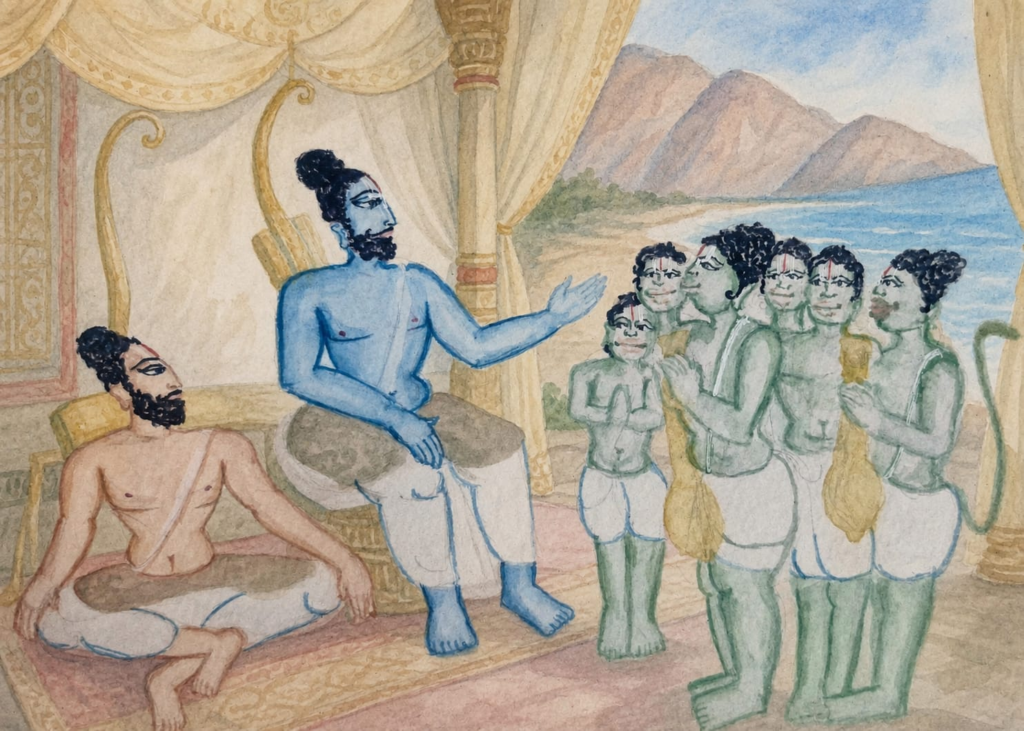
Notes from periyavAchchAn piLLai’s vyAkhyAnam
sugrIvasya thadhvAkyam SruthvA thu
Hearing sugrIva mahArArajar’s words, along with his strategy, which needed to be recognised since they came from sugrIva, even though the words were dissentient …
The word ‘thu’ conveys the distinct thought that arose in perumAL’s divine heart after hearing sugrIva mahArAja’s words.
Upon hearing sugrIva mahArAja’s words, a special compassion arose in perumAL’s divine heart for vibhIshaNAzhwAn. perumAL had a positive expectation that even if he himself had abandoned someone, sugrIva mahArAja would come forward and offer them protection. However, sugrIva mahAraja abandoning vibhIshaNAzhwAn only highlighted vibhIshaNAzhwAn’s pathetic condition (dhayanIya dhaSai). Seeing this helpless state, a unique favouritism (pakshapAtham) towards vibhIshaNAzhwAn – “Oh! There is no one other than me to help him” – arose in perumAL’s divine heart.
[puththUr swAmy’s explanation
sugrIvasya thadhvAkyam SruthvA thu – However, after hearing sugrIva’s words
Though what sugrIva said was not acceptable to him, the manner in which it was spoken commanded acceptance. Hearing sugrIva’s words gave rise to a specific thought in perumAL’s divine heart. The word ‘thu’ highlights the arising of this thought.
[Note from kAlakshEpam: perumAL intends to grant refuge to vibhIshaNAzhwAn, but sugrIva mahArAja argues against it out of intense love for SrI rAma. The word ‘thu’ conveys the contrast in SrI rAma’s divine heart – his vow of protecting the SaraNAgathan, while simultaneously being deeply moved by sugrIva’s intent despite disagreeing to his words).
perumAL trusted that sugrIva mahArAja would assume the role of purushakAram – that is, he would become an advocate for those abandoned by perumAL and recommend them to him. However, sugrIva mahArAja’s lack of support for vibhIshaNAzhwAn revealed vibhIshaNAzhwAn’s lamentable state to perumAL. Therefore, perumAL, moved by his own compassion, thought, “What a pitiable state! He has been abandoned by sugrIva too; he has no one other than me”].
rAmO mahAbala:
sugrIva mahArAja had spoken about everything with absolute appropriateness, but SrI rAma did not waver.
[puththUr swAmy’s explanation
rAmO mahAbala: – SrI rAma, one with ultimate fortitude
In this context, interpreting the word mahAbala: as ‘immense mental strength’ is more appropriate than ‘immense physical strength’ or ‘mighty’. Thus, SrI rAma is referred here as one who remained unshaken by sugrIva mahArAja’s strategic arguments].
samIpasthAn – Those who were near him. The other monkeys stood there listening to sugrIva mahArAja’s words.
hanUmathpramukhAn – hanuman and others
[perumAL speaks to ] thiruvadi and others who are as solicitous as sugrIva mahArAja, and who also act by understanding perumAL’s divine inclinations.
harInuvAcha – he spoke to monkeys
In paramapadham – priyENa sEnApathinA (the dear sEnai mudhaliyAr), fully knowing the divine intentions of emperumAn, submits his requests to him with deep reverence, while emperumAn sanctions them merely through his divine glances.
However, SrI rAma, looking at the monkeys eagerly awaiting to execute his will, addresses them seeking their permission! vAlmeeki bhagavAn seeing perumAL forsake his elite privileges, celebrates this with the words – harInuvAcha – he spoke to the monkeys!
[Note from kAlakshEpam: As a wise and venerable minister who partakes exclusively of perumAL’s SEsha prasAdham, sEnai mudhaliyAr (vishvaksEnar/SEshAsanar) holds the unique privilege of traversing all realms of paramapadham. When he enters the private quarters to submit material realm requests for divine sanction, perumAL grants his supreme approvals silently, communicating entirely through mere glances. How deeply astonishing it is, that this perumAL – who enjoys such an exalted state in paramapadham – converses with the monkeys here solely to understand their intentions and determine his next course of action!]
[puththUr swAmy’s explanation
sthOthra rathnam 42 “priyENa sEnApathinA” (He who gave his approvals through his bountiful divine glances for whatever actions which were humbly requested by dear vishvaksEnar).
In paramapadham, sEnai mudhaliyAr humbly submits his requests which perfectly align with the supreme lord’s divine intentions, and perumAL grants his approval simply through a divine glance.
Yet perumAL dismisses the superior status he enjoys in paramapadham; instead, he addresses the monkeys assembled to fulfil his will and awaits their response. vAlmeeki bhagavAn celebrates this wonderment through the words harInuvAcha].
idham uvAcha – spoke this
While everyone waited for perumAL to utter the words which would carry out his intent (that is, protecting vibhIshaNa), he instead began to speak glorifying mahArAja sugrIva.
sugrIvasya thu thadhvAkyam SruthvA rAmO mahAbala: I
samIpasthAnuvAchEdham hanUmathpramukhAn harIn II
Thus concludes the vyAkhyAnam for this SlOkam.
SrI rAmAyaNa thani SlOkam – 66 yudhdha kANdam 17.30 – yadhuktham
perumAL asks the monkeys, “Did you also hear the words that were spoken with much reasoning by sugrIva”?
avathArikai (Introduction)
perumAL embraces in his divine heart that sugrIva mahArAja’s words were spoken out of love for him, and he celebrates it.
yadhuktham kapirAjEna rAvaNAvarajam prathi I
vAkyam hEthumadharthyam cha bhavadhbhirapi thachchrutham II
Word-by-word meaning
kapirAjEna – by sugrIva, the leader of all monkeys
rAvaNAvarajam prathi – regarding rAvaNa’s brother
hEthumath – with reasons
arthyam cha – much needed
yath vAkyam – whichever words
uktham – were spoken
thath – those words
bhavadhbhi: – by you also
apiSrutham – were heard?
Simple meaning
Did you also hear the much needed words spoken with reasons by sugrIva, the chief of monkeys, about rAvaNa’s brother?
Notes from periyavAchchAn piLLai’s vyAkhyAnam
yath vAkyamuktham – that which was spoken (by sugrIva mahArAja)
Such words of sugrIva mahArAja’s words can be described or reciprocated only when we share his exact, deep love for us. The nature of those words is beyond description; at best, they can only be said as ‘that which was said’.
kapirAjEna – by the king of monkeys
It is natural for a custodian to speak with anxiety, fearing as to what might happen to those under his protection.
[puththUr swAmy’s explanation
kapirAjEna – by the king of monkeys
Isn’t this misplaced apprehension (asthAnE bhayaSankA) natural? For those who possess a treasure that needs to be carefully protected, is it not natural to fear and worry, thinking, “What harm will come to this possession”?]
Alternate interpretation for the above –
kapirAjEna yadhuktham
He spoke, displaying his prominence as a king – “samrabdham idham abhravIth”.
[puththUr swAmy’s explanation
kapirAjEna yadhuktham – those words which were spoken by the king of monkeys
Those words spoken by sugrIva mahArAja, the leader of the monkeys, made his leadership apparent.
- SrI rAmAyaNam yudhdha kANdam 16-17 “samrabdham idham abhravIth” (spoke this in great agitation). sugrIva mahArAja’s commanding words are referred to here as a display of his leadership].
rAvaNAvarajam prathi – regarding rAvaNa’s brother
Knowing his relationship with rAvaNa, there is nothing wrong with sugrIva mahArAja expressing such words out of fear. This provides a clear justification for his apprehension.
hEthumadh – he spoke with a reason
vibhIshaNAzhwAn is the younger brother and subordinate of rAvaNa, hence, when sugrIva mahArAja said, ‘let him be killed’, it was not merely a declaration, but a statement backed by specific reasons.
[puththUr swAmy’s explanation
hEthumath – with reason/justified
Thus, when sugrIva mahArAja said, “let rAvaNa’s brother be killed”, it not only shows that it was his vow, but it also demonstrates that his sentence was complete because it provided the underlying reason.
- SrI rAmAyaNam yudhdha kANdam 17-27 “vadhyathAm” (let him be killed)].
arthyam – purposeful
sugrIva mahArAja’s words, spoken out of love for perumAL, were worthy for everyone to hear. The word ‘cha’ brings together the other qualities which are not explicitly mentioned. Thus, sugrIva mahArAja’s words are interpreted not only as purposeful, but also meaningful, sweet, and concise.
bhavadhbhirapi thachchrutham
The word api here denotes a question. Was it not heard by the monkeys? That is, perumAL asks, “After hearing, how can you remain without revealing your intent”? perumAL thus tries to gain their support by trying to understand what is in their mind.
[puththUr swAmy’s explanation
bhavadhbhirapi thachchrutham – that was heard by you all also
The word api acts as a question; that is, perumAL asks, “Did you also hear it? Having heard it, how can you remain without expressing your stance either way”? When api is considered as the conjunction ‘also’, it is understood as, “Was it heard by you also”?
It can also be considered a question asked with persuasion, where perumAL attempts to sway them to his side].
yadhuktham kapirAjEna rAvaNAvarajam prathi I
vAkyam hEthumadharthyam cha bhavadhbhirapi thachchrutham II
Thus concludes the vyAkhyAnam for this SlOkam.
AzhwAr emperumAnAr jIyar thiruvadigaLE SaraNam
periyavAchchAn piLLai thiruvadigaLE SaraNam
Source – SrI rAmAyaNa thani SlOkam – 66 – yudhdha kANdam 17.28 – EvamukthvA , 17.29 – sugrIvasya, 17.30 – yadhuktham Audio Video
adiyEn chithrA rAmAnuja dhAsi
Proofreading/Curating done by – kOsalEndhra rAmAnuja dhAsan, krishNan rAmAnuja dhAsan
Artwork – namperumAL rAmAnuja dhAsan
Related Links SrI rAmAyaNa thani SlOkam – 65 – yudhdha kANdam 17.24 – rAvaNO praNihitham, 17.25 – rAkshasO jihmayA , 17.26 – pravishta: Sathrusainyam, 17.27 – vadhyathAmEsha Audio Video
SrI rAmAyaNa thani SlOkam – 64 – 17.20 – praNidhI rAkshasEndhrasya, 17.21 – athavA svayamEvaisha, 17.22 – mithrAtavI balam, 17.23 – prakruthyA Audio Video
SrI rAmAyaNa thani SlOkam – 63 – yudhdha kANdam 17.16 – Ethaththu vachanam, 17.18 – manthrE vyUhE, 17.19 – anthardhAnagathA Audio Video
SrI rAmAyaNa thani SlOkam – 62 – yudhdha kANdam 17.15 – nivEdhayatha – Part 6 Audio Video
SrI rAmAyaNa thani SlOkam – 61 – yudhdha kANdam 17.15 – nivEdhayatha – Part 5 Audio Video
SrI rAmAyaNa thani SlOkam – concise english meanings
archived in https://granthams.koyil.org
pramEyam (goal) – https://koyil.org
pramANam (scriptures) – https://granthams.koyil.org
pramAthA (preceptors) – http://acharyas.koyil.org
SrIvaishNava education/kids portal – http://pillai.koyil.org