SrI: SrImathE SatakOpAya nama: SrImathE rAmAnujAya nama: SrImath varavaramunayE nama:
The extremely merciful periyavAchchAn piLLai has selected important SlOkams from SrI rAmAyaNam and has given us a vyAkhyAna grantham known as SrI rAmAyaNa thani SlOkam. This has been published by puththUr swAmy along with a beautiful tamil commentary. We are learning the meanings of these SlOkams through these granthams. In the previous articles, we have been enjoying the 50th SlOkam in 17th sargam of yudhdha kANdam.
na vAdhAnnApi sangharshAnnAdhikyAnna cha kAmatha: I
vakshyAmi vachanam rAjan yathArtham rAmagauravAth II
This verse is uttered by thiruvadi to sugrIva mahArAja. However, in some places, it has also been explained as addressed to both perumAL and sugrIva mahArAja.
hanumAn says, “It is neither for the sake of an argument nor bias nor to establish my pride. It is also not out of expectation of any gain from vibhIshaNa. I speak having only SrI rAma’s glory in mind and I speak only the truth”.
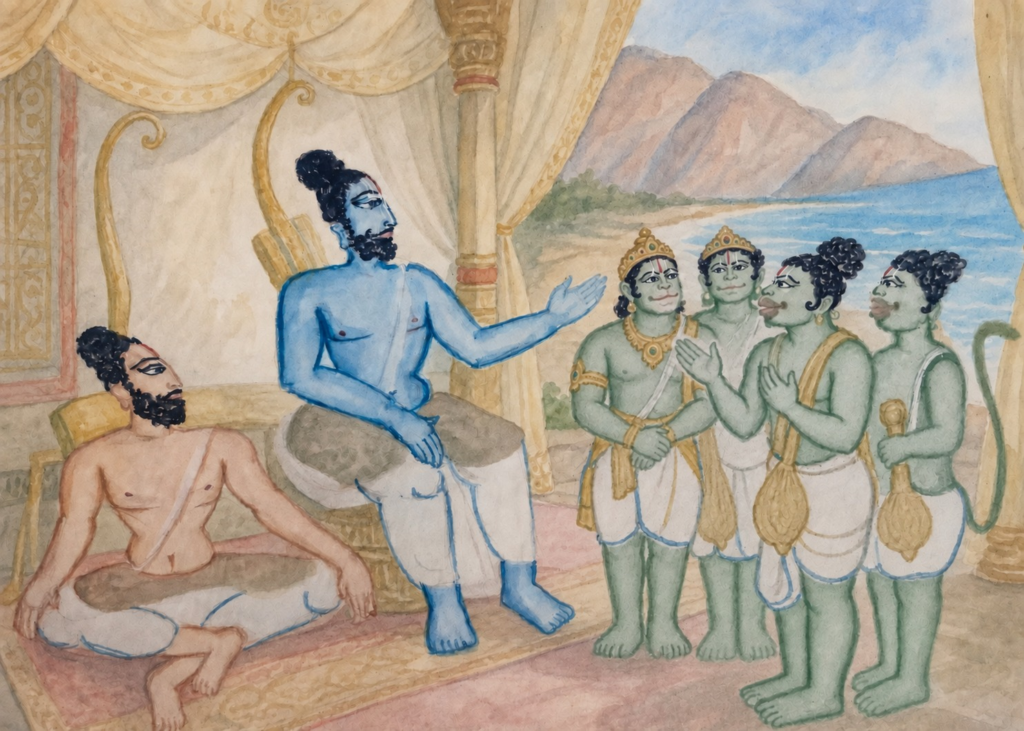
Before we proceed, we express our gratitude to periyavAchchAn piLLai and puththUr swAmy. We also express our gratitude to SrI u vE sArathy thOthAthri swAmy. This article is a translation of periyavAchchAn piLLai’s commentary, summarised with the support of SrI sArathy swAmy’s thamizh kAlakshEpam series.
Notes from periyavAchchAn piLLai’s vyAkhyAnam
So far we have enjoyed the meanings up to rAmagauravAth. We also enjoyed five different interpretations for this word. We will continue with the sixth interpretation now.
rAmagauravAth
[Note from kAlakshEpam: gauravAth – reverence and importance – has been explained in quite a few ways here. It was explained as the glory of perumAL, the greatness of the meaning of SaraNAgathi, and the honour of both perumAL and sugrIva mahArAja. Now, it is explained as the glory of SaraNAgathi].
- SrI rAmAyaNam yudhdha kANdam 18-31 “asvargyam chAyaSasyam cha bala vIrya vinASanam” (Letting the SaraNAgathan perish is akin to destruction of happiness to be obtained in the afterlife, as well as the destruction of fame, strength and vitality in the present life).
- “SaraNAgatha hanthruNAm nishkruthir na vidhIyathE” (No atonement has been even prescribed (in the SAsthram) for those who kill the surrendered).
- SrI rAmAyaNam yudhdha kANdam 18-30 “AdhAya sukrutham thasya sarvam gachchEdharakshitha:” (If a person who has sought refuge is left unprotected, he departs (to his next destination) taking away all the merits (puNyas) of the SaraNyan who watches him perish without offering protection).
Therefore, hanumAn says “I speak thinking about the multitude of misfortunes which may befall SrI rAma if a SaraNAgathan is not protected”.
gauravAth – out of respect, upon seeing the glory of vibhIshaNa
SrI rAmAyaNam AraNya kANdam 17-24 “vibhIshaNasthu dharmAthmA na thu rAkshasachEshtitha:” (SUrpaNakhA says – vibhIshaNa treads the path of righteousness, he does not engage in any of the deeds of rAkshasas).
[hanumAn says] Not only has the enemy rejected vibhIshaNa, but they themselves declare him to be virtuous. He not only follows sAmAnya dharma (general ethical duties and moral imperatives common to all), but he is also steadfast in his adherence to viSEsha dharma – surrendering to perumAL. I speak upon seeing this great glory of vibhIshaNa.
[Note from kAlakshEpam: vibhIshaNa celebrated as a virtuous person – is this valid accreditation coming from the mouth of the rAkshasas? An incident from miLagazhwAn’s life can be seen in this context. An AchArya named miLagazhwAn once heard about a king [who was unfavourable towards SrIvaishNavas] giving gifts and went there. The king said, “we won’t give you anything” and miLagAzhwAn said, “Why so? if you want to test competence in vEdham or overall SAsthram, you can do so and then give me gifts”. The king said, “You are well qualified in those. I won’t disagree”. miLagAzhwAn then asked, “Then why are you refusing me gifts?” and the king replied, “That is because, you are a SrIvaishNava”. Hearing this miLagAzhwAn took off his upper cloth, threw it up and danced for being given up by an avaishNava].
gauravAth
[hanumAn says] I speak after seeing the many favours vibhIshaNa has done for us – his daughter was sent to console pirAtti, he stopped rAvaNa from killing me who was a messenger, he offered good counsel telling rAvaNa to reunite pirAtti with SrI rAma, for our sake he advised his brother and antagonised him, he rebuked rAvaNa’s son indhrajith.
- SrI rAmAyaNam sundhara kANdam 37-11 “jyEshtA kanyA analA nAma vibhIshaNasuthA kapE I thayA mama Ethath AkhyAtham” (Oh, monkey! vibhIshaNa’s eldest daughter by name analA, having been sent by her mother, conveyed this to me).
- SrI rAmAyaNam sundhara kANdam 52-21“na dhUthO vadhamarhathi” (It is not appropriate to kill a messenger).
- SrI rAmAyaNam yudhdha kANdam 14-3 “pradhIyathAm dhASarathAya maithilee” (Let maithilee be reunited with SrI rAma).
- SrI rAmAyaNam yudhdha kANdam 14-4 “yAvanna gruhNanthi SirAmsi bANA rAmErithA rAkshasa pungavAnAm” (Let maithilee be reunited with SrI rAma before SrI rAma’s arrows severe the heads of the rAkshasa leaders).
- SrI rAmAyaNam yudhdha kANdam 15-9 “bAlasya thvam adhyA pi avipakvabudhdhi:” (vibhIshaNa says to indhrajith – You are a young child, your intellect has not fully matured yet).
- SrI rAmAyaNam yudhdha kANdam 15-11 “thvamEva vadhyaScha sudhurmathiScha” (vibhIshaNa says to indhrajith – You alone deserve to be killed; you have a highly evil intellect).
gauravAth
[hanumAn says] vibhIshaNa has performed SaraNAgathi, encompassing all six qualities. How can such a SaraNAgathan be rejected? I speak because of this greatness of possessing the complete SaraNAgatha lakshaNam.
- ahirbudhnya samhithai 37 – 27 “AnukUlyasya sankalpa: prAthikUlyasya varjanam | rakshishyathIthi viSvAsO gOpthruthva varaNam thathA | Athma nikshEpa kArpaNyE shadvidhA SaraNAgathi: ||” (1. vowing to remain favourable towards all (bhagavAn and bhAgavathas); 2. refraining from unfavourable aspects, 3. having faith that bhagavAn, the owner, will protect his belongings, 4. praying to bhagavAn to protect the self, 5. placing self under his protection, 6. being empty-handed/helpless. SaraNAgathi constitutes these six characteristics).
[hanumAn says] vibhIshaNa has a favourable trait towards everyone; he desired auspiciousness even for his enemy. Although he possessed a mace, he did not use it to pummel and make rAvaNa cry – the one who humiliated him. Instead, he simply walked away, thereby exhibiting restraint against unfavourable actions.
- SrI rAmAyaNam yudhdha kANdam 16-23 “svasthi thE’sthu” (May there be auspiciousness with you).
- SrI rAmAyaNam yudhdha kANdam 16-16 “uthpapAtha gadhApANI:” (He soared into the sky, holding a mace in his hand).
[hanumAn says] vibhIshaNa has arrived here after hearing about vAli and sugrIva mahArAja, trusting that perumAL will protect him. By saying, “I surrender, protect me”, he has offered his prayers. By surrendering everything to SrI rAma, he makes a total-surrender, and his weak cry reveals his desperate condition. Does he not possess in full measure all the qualities of SaraNAgathi?
- SrI rAmAyaNam yudhdha kANdam 17-64 “vAlinancha hatham SruthvA sugrIvancha abhisEchitham I rAjyam prArthayamAnaScha” (After hearing about vAli’s death and sugrIva mahArAja crowned as the king, he has come with a desire for his kingdom).
- SrI rAmAyaNam yudhdha kANdam 19-5 “bhavantham SaraNam gatha:” (I surrender to dhEvarIr).
- SrI rAmAyaNam yudhdha kANdam 19-6 “bhavadhgatham mE rAjyancha jIvithancha sukhAni vai” (My kingdom, life, happiness, everything rest in dhEvarIr).
- SrI rAmAyaNam yudhdha kANdam 18-14 “praNAdhaScha mahAnEshas thathOsya bhayamAgatham” (His tone – his feeble cry for help indicates his fear for rAvaNa).
gauravAth
[Next, hanumAn highlights the vibhIshaNAzhwAn’s nature, the mannerism in which he speaks, and his facial expressions].
- SrI rAmAyaNam yudhdha kANdam 17-60 “na thvasya bruvathO jAthu lakshyathE dhushtabhAvathA I prasannam vadhanam chApi” (Even while he speaks, no malice or evil intention can ever be detected in him; and his face also remains serene).
[hanumAn says] We cannot see any defect while he speaks; he also remains pleasant. Anyone who speaks with clarity and without hesitation must possess a noble heart. He did not stumble in his speech, nor was his speech incoherent or contradictory. If someone tries to hide their intentions, those intentions will become obvious through their words without their knowledge. Therefore, vibhIshaNa is not evil; it can be concluded that he is a well-wisher. I speak these words, since there are many intellectual subtleties with him to enable us to conclude about him.
na vAdhAnnApi sangharshAnnAdhikyAnna cha kAmatha: I
vakshyAmi vachanam rAjan yathArtham rAmagauravAth II
Thus concludes the vyAkhyAnam for this SlOkam.
SrI rAmAyaNa thani SlOkam – yudhdha kANdam 17.51
In this verse, hanumAn explains the flaws present in the perspectives of those who spoke earlier.
avathArikai (Introduction)
The flaws present in the first perspective conveyed by angadhap perumAL are explained in this SlOkam.
arthAnarthanimiththam hi yadhuktham sachivais thava I
thathra dhOsham prapaSyAmi kriyA na hyupapadhyathE II
Word-by-word meaning
thava – dhEvarIr’s
sachivai: – by ministers, angadhap perumAL
arthAnarthanimiththam – regarding the advantages and disadvantages
yath – that statement
uktham – was spoken
thathra – in that perspective
dhOsham – flaw
prapaSyAmi – I see very clearly
hi – because
kriyA – examining
na upapadhyathE – is not appropriate
Simple meaning
I vividly see the flaws in the ministers’ counsel (angadhap perumAL) regarding analysing the advantages and disadvantages of accepting vibhIshaNa. Such an examination is not possible.
Notes from periyavAchchAn piLLai’s vyAkhyAnam
arthAnarthanimiththam hi yuktham – the strategy that was spoken – to accept or reject based on pros and cons
The perspective to make a decision of accepting vibhIshaNa based on advantage and rejecting him for disadvantage
thava sachivai: – by dhEvarIr’s ministers
[hanumAn says] They are dhEvarIr’s ministers; however, without realising dhEvarIr’s true nature, they spoke merely by following the scriptures.
The word sachivai: is plural. Why does hanumAn say ‘ministers’ (in the plural) while talking about angadhap perumAL? All those who are aligned with angadhap perumAL’s thoughts accept his perspective. Therefore, it is interpreted to include everyone in agreement with angadhap perumAL. Hence, it is conveyed in the plural form.
Alternatively, it could be interpreted that the plural form is used as an honorific out of respect for the prince, angadhap perumAL.
Why is hanumAn not aligned with angadhap perumAL’s perspective? It is not due to lack of respect, but because following that perspective will not yield the desirable result.
thathra dhOsham prapaSyAmi – I see very well the flaw in that
Although angadhap perumAL has conveyed his thoughts after careful analysis, the flaws in his perspectives are apparent.
kriyA na hyupapadhyathE – for an action is not logical
Indeed such an action – of examining vibhIshaNa is not possible.
arthAnarthanimiththam hi yuktham sachivais thava I
thathra dhOsham prapaSyAmi kriyA na hyupapadhyathE II
Thus concludes the vyAkhyAnam for this SlOkam.
SrI rAmAyaNa thani SlOkam – yudhdha kANdam 17.52
The thought expressed in the previous SlOkam is elaborated here.
avathArikai (Introduction)
This SlOkam elaborates his [hanumAn’s] statement – It is not possible to examine him [vibhIshaNa].
ruthE niyOgAth sAmarthyam avabOdhdhum na SakyathE I
sahasA viniyOgO hi dhOshavAn prathibhAthi mA II
Word-by-word meaning
niyOgAth ruthE – without entrusting in a task
sAmarthyam – (his) benefits
avabOdhdhum – to understand
na SakyathE – not possible
sahasA – quickly
viniyOga: hi – to engage him in a task
dhOshavAn – as a mistake
mA – to me
prathibhAthi – it appears
Simple meaning
[hanumAn says] Without entrusting any work, it is not possible to understand the benefits of his actions. However, it is also not possible to entrust any work to a new entrant very quickly. Therefore, I see this as a mistake.
Notes from periyavAchchAn piLLai’s vyAkhyAnam
niyOgAth ruthE sAmarthyam avabOdhdhum na SakyathE
sAmarthyam means that which will yield exceptional results.
Without assignment to a task, the capability cannot be understood.
Then, why is it not possible to engage him in a task?
sahasA viniyOgO hi dhOshavAn prathibhAthi mA
To immediately entrust him with a task seems erroneous to me. It may result in a disaster if he is assigned to something immediately. If he is evil, it will definitely result in catastrophe. Even if he is noble, his actions may not yield the desired result since he is new. Therefore, we cannot entrust him with any action without knowing for certain that his actions will be beneficial to us.
However, without entrusting him, how do we figure out whether he is beneficial or not?
Therefore, due to this reciprocal connection, a logical flaw arises (described as anyOnyASrayaNam – mutual dependence). Hence, examining him is not possible.
ruthE niyOgAthsAmarthyam avabOdhdhum na SakyathE I
sahasA viniyOgO hi dhOshavAn prathibhAthi mA II
Thus concludes the vyAkhyAnam for this SlOkam.
AzhwAr emperumAnAr jIyar thiruvadigaLE SaraNam
periyavAchchAn piLLai thiruvadigaLE SaraNam
Source – SrI rAmAyaNa thani SlOkam – 72 – yudhdha kANdam 17.50 – Part 3, 17.51,17.52 Audio Video
adiyEn chithrA rAmAnuja dhAsi
Proofreading/Curating done by – kOsalEndhra rAmAnuja dhAsan, krishNan rAmAnuja dhAsan
Artwork – namperumAL rAmAnuja dhAsan
Related Links
SrI rAmAyaNa thani SlOkam – 71 – yudhdha kANdam 50 – Part 2 Audio Video
SrI rAmAyaNa thani SlOkam – 70 – yudhdha kANdam 17.48 – 50 – Part1 Audio Video
SrI rAmAyaNa thani SlOkam – 69 – yudhdha kANdam 17.41 – 47 Audio Video
SrI rAmAyaNa thani SlOkam – 68 – yudhdha kANdam 17.38 – 40 Audio Video
SrI rAmAyaNa thani SlOkam – 67 – yudhdha kANdam 17.31 – suhruthA, 17.32 – ithyEvam, 17.33 – agyAtham, 17.34 – thvam hi Audio Video
SrI rAmAyaNa thani SlOkam – concise english meanings
archived in https://granthams.koyil.org
pramEyam (goal) – https://koyil.org
pramANam (scriptures) – https://granthams.koyil.org
pramAthA (preceptors) – http://acharyas.koyil.org
SrIvaishNava education/kids portal – http://pillai.koyil.org