SrI: SrImathE SatakOpAya nama: SrImathE rAmAnujAya nama: SrImath varavaramunayE nama:
We are currently enjoying the in-depth meanings of SrI rAmAyaNa SlOkams from the yudhdha kANdam, based on periyavAchchAn piLLai’s commentaries (vyAkhyAnam) and puththUr swAmy’s lucid explanations.
We express our gratitude to periyavAchchAn piLLai and puththUr swAmy for their mercy, and to SrI u vE sArathy thOthAthri swAmy for providing us with this opportunity through his thamizh kAlakshEpam of periyavAchchAn piLLai’s vyAkhyAnam.
This article is a translation of SrI sArathy swAmy’s thamizh kAlakshEpam.
vibhIshaNAzhwAn departs from lankA and reaches the northern shore. At that time, he is seen along with his four rAkshasa companions by sugrIva mahArAja and other monkeys. After a quick discussion, they determine that the five rAkshasas have come to kill perumAL and iLaiya perumAL; they pick up trees and mountains as weapons to kill them. At this juncture, standing in the sky, vibhIshaNAzhwAn starts to speak to them in a loud voice. He introduces himself and says, “rAvaNa is a rAkshasa with evil conduct. He is the leader of the rAkshasas. I am his younger brother, vibhIshaNa”.
vibhIshaNAzhwAn arrives with the intention to surrender. Revealing one’s own lowliness, declaring what is worthy of attachment, and identifying what must be abandoned are essential parts of SaraNAgathi. These principles are expressed very clearly by vibhIshaNAzhwAn in five SlOkams, starting from SlOkam 10 in sargam 17. We shall now enjoy the second SlOkam in this order.
avathArikai (Introduction)
periyavAchchAn piLLai has given two introductions for this.
In the previous SlOkam, rAvaNa’s conduct was described as “dhurvruththa:” or immoral due to his rAkshasa nature and his position as the leader of all rAkshasas. While the sins arising from such evil conduct could be eliminated through atonement, rAvaNa also committed bhAgavatha apachAram (offence against devotees) by killing jatAyu mahArAja and abducting sIthAp pirAtti.
In varAha purANam, varAhap perumAL tells bhUmip pirAtti that he will not forgive (na kshamAmi) offences committed towards his devotee – even if that devotee happens to consume dog meat. He asserts that such offenders are sure to face his punishment.
- varAha purANam “madhbhaktham Svapacham vApi nindhAm kurvanthi yE narA: I padhmakOtiSathEnApi na kshamAmi vasundharE II” (varAhap perumAL declares: Oh, bhUmi dhEvi! If one commits an offence, such as criticising or abusing my devotee – even if that devotee happens to be a chaNdAlan (one without AchAram, anushtAnam, or merits, and who does not follow varnASrama dharma) – I do not forgive such an offender, even in a hundred crore padhma kAlam (one padhma kAlam is one day of brahmA)).
[Note from kAlakshEpam: krishNa says, ‘kshipAmi’ (I push them) in bhagavath gIthA 16-19 “thAn aham dhvishatha: krUrAn samsArEshu narAdhamAn | kshipAmyajasram aSubhAn AsurIshvEva yOnishu ||” (I continuously push those demoniac people – who are hateful towards me, cruel, lowly amongst men, and inauspicious – into repeated births (which contain repeated birth, death, old-age and disease) which are specifically demoniac in nature). Committing bhAgavatha apachAram makes emperumAn furious. It is said that while bhagavath apachAram (offences towards the lord) is like stabbing the divine hands or feet of the lord with a sword, bhAgavatha apachAram is like stabbing his divine chest, the eternal abode of pirAtti. This is never tolerated by bhagavAn. This comparison is made to stress the exceptionally cruel and grave nature of such a sin.]
Thus, vibhIshaNAzhwAn says that rAvaNa has also committed offences for which there is no atonement.
The second interpretation:
Alternatively, “dhurvruththa:” or evil conduct actually implies the offence committed towards pirAtti. In this manner, vibhIshaNAzhwAn begins to explain in this SlOkam.
thEna sIthA janasthAnAdhdhruthA hathvA jatAyusham I
rudhdhA cha vivaSA dhInA rAkshasIbhis surakshithA II
Word-by-word meaning
thEna – by that rAvaNa (with immoral conduct)
jatAyusham – jatAyu mahArAja
hathvA – killed
janasthAnAdh – from janasthAnAm
hruthA – one, who was abducted
sIthA – sIthAp pirAtti
rAkshasIbhi: – by the rAkshasis [demonic women)
surakshithA – guarded well
vivaSA – as a dependent
dhInA – in distress
rudhdhA – (in aSOka forest) was imprisoned
Simple meaning
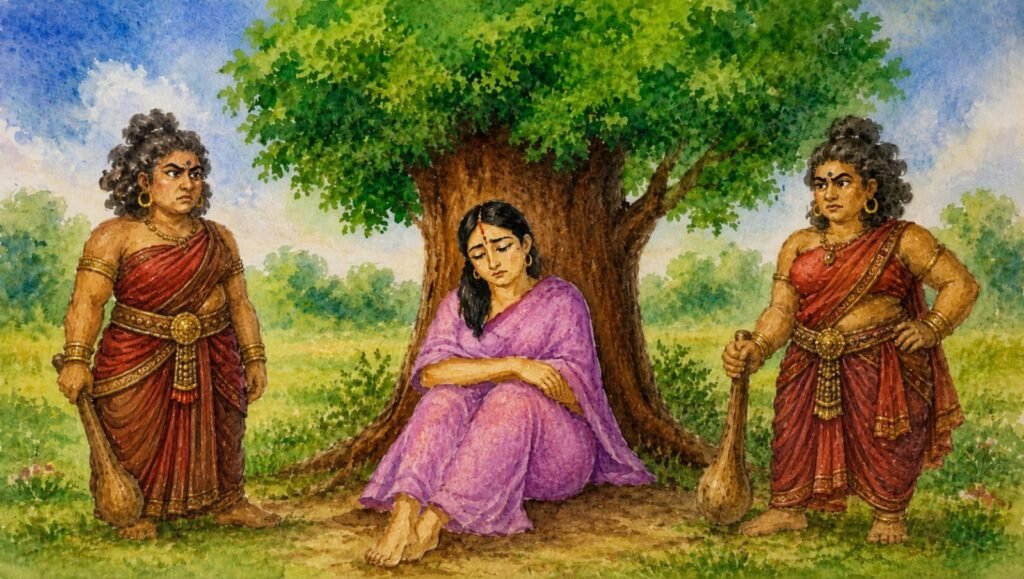
sIthAp pirAtti was abducted by that rAvaNa from janasthAnam after killing jatAyu mahArAja. She was then confined, helpless, distressed, and kept under strict guard by the rAkshasis.
Notes from periyavAchchAn piLLai’s vyAkhyAnam
thEna hruthA – she was abducted by him (rAvaNa)
sIthAp pirAtti was abducted by rAvaNa, who is a repository of all the dhOshams (faults), mentioned in the previous SlOkam. For him to be engaged in this outrageous act – that exceeds all the boundaries of moral code – he must be an utmost sinner. He must have previously committed grave sins even to perform this kind of asahya apachAram (offences committed without any reason), abducting the jaganmAthA.
hruthA – abducted
rAvaNa abducted pirAtti – she who is eternally with perumAL – and separated her from perumAL.
- SrI rAmAyaNam sundhara kANdam 21-13 “ananyA rAghavENAham” (I am inseparable from rAma pirAn, like radiance from the sun).
- SrI rAmAyaNam ayOdhyA kANdam 53-31 “jalAnmathsyAvivOdhruthau” (iLaiya perumAL says, “SrI rAma! Separated from you, neither sIthAp pirAtti nor I will survive. Just as a fish that is taken out of water will live only for a short duration, we will not survive beyond a moment, if we are separated from you).
sIthA hruthA – sIthAp pirAtti was separated
What was sIthAp pirAtti’s nature? She was a sukumAri (a gentle woman). Without causing any shortcoming to her delicate nature (saukumAryam) as it is in paramapadham, she appeared on the earth.
rAvaNa abducted that sIthAp pirAtti, who is without any blemish such as residing in a womb. “sIthA lAngalapadhdhathi:” (sIthA refers to a line cut into the soil by a plough). sIthAp pirAtti was thus named as she appeared in a furrow while king janaka was plowing a field.
parASara bhattar mentions in SrI guNarathna kOsam “pAdhArundhudhamEva pankajaraja:” (The divine feet were distressed by the pollen of the lotus flower). perumAL, considering pirAtti’s delicate nature and knowing that residing in a womb would cause harm to her tenderness, resolved that she would be born as an ayOnija (not born from a womb), without any shortcoming to her tenderness which she has in paramapadham.
That heinous sinner [rAvaNa] separated pirAtti, who has such tenderness, from perumAL.
janasthAnAdhdhruthA – she was abducted from janasthAnam
sIthAp pirAtti, [as a yuvarAni, princess] could not very easily go outside; “asUryampaSyA rAjadhArA:” (the women in palaces do not see the sun), so the palace in thiruvayOdhyA felt like a prison to her. However, she was happy in the forest – plucking the flowers, bathing in the rivers, and enjoying nature with perumAL. rAvaNa separated pirAtti from perumAL while she was living happily with him in janasthAnam.
hruthA – she was abducted
[Note from kAlakshEpam: When vAlmeeki bhagavan goes to bathe in the river, he sees a hunter kill one of the two krauncha birds while they are mating. Although vAlmeeki bhagavAn is a sage who has renounced his desires, he is deeply saddened by this and utters the following SlOkam.]
- SrI rAmAyaNam bAla kANdam 2-15 “mA nishAdha prathishtAmva I magama: SASvathI: samA: I yath krauncha mithunAth Eka I mavadhI: kAma mOhitham II” (Oh, hunter! May you never attain lasting fame for endless years, because you have killed one of the two krauncha birds while it was in lustful passion).
Even a sage like vAlmeeki bhagavAn, who is firmly established in detachment, could not tolerate the act of separating a pair. Yet, rAvaNa engaged in such an act and separated pirAtti.
[Note from kAlakshEpam: bANAsura’s daughter, ushA desires anirudhdhAzhwAn [grandson of krishNa]. Her friend, chithralEkhA, brings anirudhdhAzhwAn and unites them. They live happily. When bANAsura comes to know about this, he immediately imprisons both of them together.]
Just like bANAsura imprisoned both his daughter, ushA, and anirudhdha who was her beloved, it would have been tolerable even if rAvaNa had kept both perumAL and pirAtti together in captivity. Instead, rAvaNa used mArIcha, the illusory deer, to separate and torment them.
jatAyusham hathvA hruthA – he killed jatAyu mahArAja and pirAtti was abducted
[Note from kAlakshEpam: When krishNa went as a messenger on behalf of the pANdavas, dhuryOdhana asked him as to why he did not stay with him, with the most exalted bhIshma or the kula guru, dhrONAchArya. He asked krishNa why he chose to eat at vidhura’s residence instead. krishNa told dhuryOdhana that it is not appropriate to consume food at an enemy’s residence. dhuryOdhana asked, “Why do you consider me as your enemy?” At that time, krishNa told him, “pANdavas are like life itself to me”.]
- mahAbhAratham udhyOga parva 1-27 “mama prANA hi” (pANdavas are my life breath).
- bhagavath gIthA 7-18 “gyAnI thvAthmaiva mE matham” (A gyAni [one with deep, spiritual knowledge] who is fully devoted to me is my AthmA – this is my philosophy).
[Note from kAlakshEpam: It is paramAthmA’s presence as antharyAmi that provides existence to all beings. However, the lord says that the reason for his own existence is the gyAnis.]
jatAyu mahArAja was one such great person. He was very dear to perumAL, who revered him like a father. Our pUrvArchAryas venerate him as ‘periyavudaiyAr’. Unlike the case when he abducted and captivated pirAtti, rAvaNa killed jatAyu mahArAja, separating him from perumAL in an irretrievable manner.
Due to his profound hostility towards chakravarthith thirumagan, SrI rAma, rAvaNa voluntarily brought danger upon his friends, relatives, and himself, risking the destruction of everyone.
- SrI rAmAyaNam bAla kANdam 15-27 “sa mithra gyAthi bAndhavam” (Along with his friends, cousins, and relatives).
rudhdhA cha – she was imprisoned
Even after separating them, he could have felt sympathy after a little while and reunited pirAtti with perumAL. But he did not do that. Instead, he kept her in captivity in an inaccessible place, the aSOka forest, away from everyone’s eyes, in a stifling manner.
[Note from kAlakshEpam: sIthAp pirAtti was surrounded by many rAkshasis (roughly around 700 of them). She felt constricted, unable to even breathe. She was imprisoned in such a manner by rAvaNa.]
vivaSA – subdued by others
As noticed by parAnguSa nAyaki’s mother, pirAtti remained fully subdued. Her anguish due to her separation from perumAL was noticeable, and she remained under the control of those around her.
- thiruvAimozhi 7-2-4 “itta kAl itta kaiyaLAy” (The leg and hand remain motionless wherever they were placed).
[Note from kAlakshEpam: parAnguSa nAyaki, separated from perumAL, is unconscious. Her mother notices that parAnguSa nAyaki’s leg and hand remain motionless.]
dhInA – she is in a very distressing state
She regretted, “In this distressed state, is there someone to provide sustenance for me?” She regrets that her state of weakness is apparent to everyone.
As denoted by the term ‘dhEvajushtA’ (pleased by the divine), she continuously enjoyed the bliss of togetherness with perumAL. However, rAvaNa has now agonised her by separating her from perumAL.
rAkshasIbhis surakshithA – she was watched over strictly by the rAkshasis
pirAtti was surrounded by rAkshasis like EkAkshi (the one-eyed rAkshasi), Eka karNi (the one-eared rAkshasi), who possessed abnormal and terrifying appearances, speech and conduct. They kept her under such strict vigilance that even after thiruvadi – who could offer her solace – obtained her divine dharSan, he could not immediately approach her.
[Note from kAlakshEpam: No matter how big one’s mistakes are, when he comes to surrender, perumAL will accept him. Everyone has the right to attain bhagavAn – no matter what kind of person he/she is, no matter what caste, irrespective of varNam, man or woman, without any distinction regarding country, poor or rich, wise or unwise, righteous or unrighteous. This eligibility to attain perumAL will fructify, when one surrenders to perumAL, declaring their lowliness. In this aspect, we must remain open-minded and perceive all servitors worthy of attaining emperumAn. Thus, we do not have authority to show prejudice and eliminate certain servitors as ineligible. However, with respect to AchAram and anushtAnam, one must be strict in adhering to their discipline. krishNa says, “samO’ham sarvabhUthEshu” (I am equal towards everyone who wants to take refuge in me [bhagavath gIthA 9-29]) When emperumAn says that he treats all surrendered AthmAs as equal, we are no one to create differences as high or low. Thus, everyone has the right to attain perumAL.]
Thus, vAlmeeki bhagavAn, who has fully realised the meaning of vEdham, has illustrated in this SlOkam and the previous SlOkam that even those like rAvaNa, who have committed the utmost sins – indescribable by speech and incomprehensible to the intellect of the all the jIvAthmAs – are still qualified to seek the refuge of emperumAn.
This is further corroborated by the following pramANams.
- vishNu dharmam 106-53 “SaraNam thvAm prapannAnAm thavAsmIthi cha yAchathAm I prasAdham pithruhanthruNAmapi kurvanthi sAdhava: II” (To those who have surrendered to you, and to those who implore ‘I belong to you’, even if they have killed their fathers, the virtuous people bestow their grace upon them).
- sanath-kumAra-samhithA “kuyOnishvapi sanjAthO yassakruchcharaNangatha: I tham mAthApithruhanthAramapi pAthi bhavArthihA II” (Even when a surrendered person has taken a birth in a lowly form, even if he has killed his mother and father, the physician, maNivaNNan [like a bluish gemstone], the one who cures the disease of birth, rescues him).
- “dhurAchArOpi sarvASI kruthanO nAsthika: purA I samASrayEdhAdhidhEvam SradhdhayA SaraNam yadhi I nirdhOsham vidhdhi tham janthum prabhAvAth paramAthmana:” (Even if one has had immoral conduct since time immemorial, has indulged in eating anything they desire, has been an ingrate, without conviction in SAsthram, if he surrenders with faith to the eternal supreme lord, know him as a person who has been made sinless by the mercy of paramAthmA).
- yajussamhithai 6-6-20 “dhEvA vai yagyAth rudhhramantharAyan sa AdhithyAnanvAkramatha thE dhvithaivathyAth prApathyantha thAn na prathiprAyachchan thasmAdhapi yadhyam prapannam na prathiprayachchanthi” (The dhEvas denied to give rudhran his share of the sacrificial offering; so, rudhran started to kill the dhEvas. The dhEvas surrendered to aSwinIdhEvas; the aSwinIdhEvas did not expose them. Therefore, if one has surrendered, they must not be betrayed even if they are worthy of being killed).
The following pramANam is included by putthUr swAmy:
- yajussamhithai 6-5-29 “dhEvEna thvashtrA sOmam pibEthyAha I thvashtA vai paSUnAm mithunAnAm rUpakruth rUpamEva paSushu dhadhAthi I dhEvA vai thvashtAramajighAmsan I sa pathnI: prApathyatha II tham na prathiprAyachchanthi II” (thvashtA, the dhEva, (once, in a yAgam) vowed to drink ‘sOmapAnam’ or sOma juice. (For that purpose), he took the form of male and female cows and attempted to drink the soma juice. (On seeing that), the dhEvas desired to kill thvashtA. Upon knowing their intention, thvashtA surrendered to the wives of dhEvas. Those wives of the dhEvas did not reveal thvashtA’s identity to the dhEvas. Therefore, if one has surrendered, they must not be betrayed even if they are worthy of being killed).
thEna sIthA janasthAnAdhdhruthA hathvA jatAyusham I
rudhdhA cha vivaSA dhInA rAkshasIbhis surakshithA II
This concludes the vyAkhyAnam for this SlOkam.
AzhwAr emperumAnAr jIyar thiruvadigaLE SaraNam
periyavAchchAn piLLai thiruvadigaLE SaraNam
Source – SrI rAmAyaNa thani SlOkam – 55 – yudhdha kANdam 17.11 – thEna sIthA Audio Video
adiyEn chithrA rAmAnuja dhAsi
Proofreading/Curating done by – kOsalEndhra rAmAnuja dhAsan, krishNan rAmAnuja dhAsan
Artwork – namperumAL rAmAnuja dhAsan
Related Links
SrI rAmAyaNa thani SlOkam – 54 – yudhdha kANdam 17.8 – thEshAm, 17.9 – uvAcha cha, 17.10 – rAvaNO nAma Audio Video
SrI rAmAyaNa thani SlOkam – 53 – yudhdha kANdam 17.5 – Esha sarvAyyudhOpEtha:, 17.6 – sugrIvasya, 17.7 – SIgram vyAdhiSa Audio Video
SrI rAmAyaNa thani SlOkam – 52 – yudhdha kANdam – 16.1 – sunivishtam, 17.1 – ithyukthvA Audio Video
SrI rAmAyaNa thani SlOkam – 51 – yudhdha kANdam – 16.1 – sunivishtam, 17.1 – ithyukthvA Audio Video
SrI rAmAyaNa thani SlOkam – 50 – yudhdha kANdam – abhaya pradhAna sAram – pravESam (Introduction) Audio Video
SrI rAmAyaNa thani SlOkam – concise english meanings
archived in https://granthams.koyil.org
pramEyam (goal) – https://koyil.org
pramANam (scriptures) – https://granthams.koyil.org
pramAthA (preceptors) – http://acharyas.koyil.org
SrIvaishNava education/kids portal – http://pillai.koyil.org