SrI: SrImathE SatakOpAya nama: SrImathE rAmAnujAya nama: SrImath varavaramunayE nama:
The extremely merciful periyavAchchAn piLLai has selected important SlOkams from SrI rAmAyaNam and provided us with a vyAkhyAna grantham known as SrI rAmAyaNa thani SlOkam. Along with this, he has additionally explained the yudhdha kANdam SlOkams in abhaya pradhAna sAram. All of this has been published by puththUr swAmy along with a beautiful tamil commentary. We are learning the meanings of these SlOkams through these granthams.
We express our gratitude to periyavAchchAn piLLai and puththUr swAmy. We also express our gratitude to SrI u vE sArathy thOthAthri swAmy. This article is a translation of periyavAchchAn piLLai’s commentary, summarised with the support of SrI sArathy swAmy’s thamizh kAlakshEpam series.
hanumAn explains the flaws in the perspectives of all those who spoke earlier. He begins with describing the problems in the execution of angadhap perumAL’s opinion
This verse is uttered by thiruvadi to sugrIva mahArAja. However, in some places, it has also been explained as being addressed to both perumAL and sugrIva mahArAja. He also humbly conveys that there is no flaw in the individual who expressed the opinion – it is only in the opinion itself. He also begins to explain the flaws in the opinions of Sarabhan, jAmbavAn and maindhan.
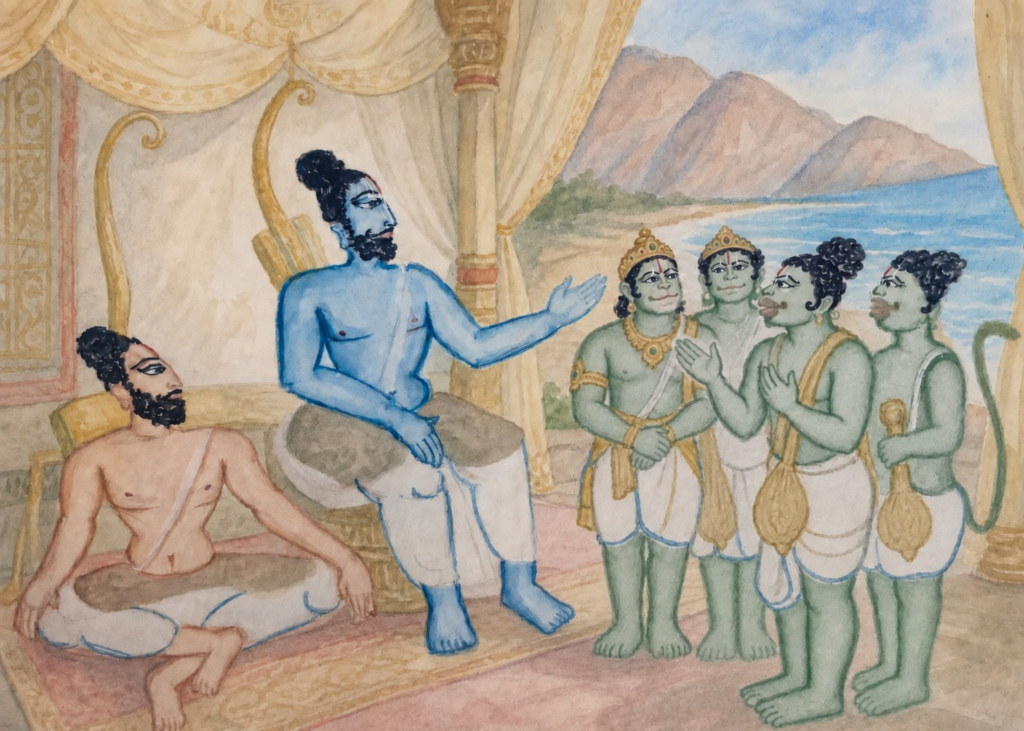
A beautiful point to be taken is highlighted through this – There may be differences of opinion among the servitors of perumAL, but these should not be considered as individual hostility, but rather as differences in perspective. hanumAn precisely does this here by highlighting the flaws in the opinions of these great authorities and devoted servitors. Due to our connection with prakruthi, it is possible to make some mistakes even as servitors to the lord. Other servitors can bring these to the attention of those making mistakes at an appropriate time and place. However, it has to be done humbly and with respect, emphasising that it is only the opinion that is disagreeable, with no personal conflict. This is beautifully illustrated by hanumAn here.
SrI rAmAyaNa thani SlOkam – yudhdha kANdam 17.53
avathArikai (Introduction)
hanumAn expresses that Sarabhan’s perspective is incorrect.
chArapraNihitham yuktham yadhuktham sachivais thava I
arthasyAsambhavAth thathra kAraNam nOpapadhyathE II
Word-by-word meaning
chArapraNihitham – sending a spy
yuktham – (as) befitting
yath – which
thava – your (dhEvarIr)
sachivai: – by ministers, Sarabhan
uktham – was said
thathra – in that matter
arthasya asambhavAth – there is nothing for a spy to do (on this person)
kAraNam – reason
na upapadhyathE – is not apt
Simple meaning
The opinion expressed by your ministers (Sarabhan) as befitting – to send a spy, is not possible because it is impractical.
Notes from periyavAchchAn piLLai’s vyAkhyAnam
chArapraNihitham yuktham yadhuktham thava sachivai: – the idea proposed by your ministers – to send a spy is inappropriate
The word praNihitham is used here in the sense of praNidhAnam, meaning employment of that (sending a spy) leads to an action. In this context, it refers to the proposal of sending a spy.
thathra kAraNam nOpapadhyathE – The principle underlying that proposal is not appropriate. It is completely devoid of logic. That is, it is not something to be achieved by a spy.
arthasya asambhavAth –
[A spy is sent when the enemy cannot be seen by us]. He stands right in front of us, so there is no need for a spy to be sent.
Alternatively, if it is read as ‘arthasyA sambhavAth chAraNam nOpapadhyathE’ – replacing kAraNam with chAraNam – it cannot be interpreted this way since it is not meaningful.
Next is the explanation for the word artha. Through this word, meanings such as kings, royal chambers, royal assembly etc. are implied. Normally, a spy is sent to learn about an emperor’s subordinate king, to understand specific propaganda discussed in a meeting or to know about the affairs within the royal chambers. There is no such need in this circumstance, since vibhIshaNa has come directly to them and stands right before their eyes. Therefore, it is said that sending a spy is not meaningful.
chAraNam – espionage
- kAmandhaka nIdhi SAsthram 13-36 “vaNik krusheevalO lingee bhikshukO’ dhyApakas thathA I samasthA: syu: chArasamsthithyai dhaththadhAyA: sukhASrayA: II” (Disguises of a trader, farmer, ascetic, monk, or teacher are all suitable for a spy. For a spy who is disguised as such, facilities for his survival and existence must be provided).
All these professions are included in the meaning of this word chAraNam. Therefore, if vibhIshaNa has any subordinate kings under him, a royal chamber or an assembly, spies disguised as traders, farmers, ascetics, monks, or teachers could be sent to gather intelligence. Since these are not suitable in this predicament, espionage is not appropriate.
chArapraNihitham yuktham yadhuktham sachivais thava I
arthasyAsambhavAth thathra kAraNam nOpapadhyathE II
Thus concludes the vyAkhyAnam for this SlOkam.
SrI rAmAyaNa thani SlOkam – yudhdha kANdam 17.54
jAmbavAn stated that vibhIshaNa arrived at the wrong time and place of arrival – lankA is on the verge of a battle, and it was night time. In this verse, hanumAn explains the flaws present in jAmbavAn’s perspectives and proves that vibhIshaNa’s arrival was actually correct – at the right time and place.
avathArikai (Introduction)
In the next three SlOkams, hanumAn details the flaws in the perspective of SrI jAmbavAn, the king of bears.
adhESakAlE samprAptha ithyayam yadhvibhIshaNa: I
vivakshA chA’thra mE’sthIyam thAm nibOdha yathAmathi II
Word-by-word meaning
ayam vibhIshaNa: – this vibhIshaNa
adhESakAlE – inappropriate place and time
samprAptha – has arrived
ithi – thus
yath uktham – which was spoken
athra – in this opinion
mE – for me
iyam vivakshA – desire to say convey this
asthi – possess
thAm cha – that desire (to speak)
yathAmathi – as understood (by me)
nibOdha – (dhEvarIr) please hear
Simple meaning
It has been said that vibhIshaNa arrived at the wrong place and time. In this matter, I desire to express my understanding. dhEvarIr, please listen to my thoughts.
Notes from periyavAchchAn piLLai’s vyAkhyAnam
ayam vibhIshaNa: – this vibhIshaNan – who was humiliated by rAvaNa, surrendered at dhEvarIr’s divine feet, expressing his lowliness.
- SrI rAmAyaNam yudhdha kANdam 16-15 “thvAm thu dhikkulapAmsanam” (Oh, destroyer of race! A curse upon you).
- SrI rAmAyaNam yudhdha kANdam 17-14 “dhAsavachchAvamAnitha:” (I was humiliated like a servant).
- SrI rAmAyaNam yudhdha kANdam 17-10 “thasyA’hamanujO bhrAthA vibhIshaNa ithi Srutha:” (I am the younger brother of that rAvaNa; I am named as vibhIshaNan (extremely dreadful person)).
- SrI rAmAyaNam yudhdha kANdam 17-14 “rAghavam SaraNam gatha:” (I have come to surrender to rAghavan).
adhESa kAlE samprAptha ithi thava sachivairyadhuktham athra mE iyam vivakshA chAsthi, yathA mathi thAm nibOdha – [hanumAn says] I have the following thought regarding the opinion expressed by dhEvarIr’s ministers – that he has arrived at the wrong place and wrong time. I will explain it to the best of my ability; dhEvarIr, please listen to it.
[hanumAn says] dhEvarIr, please listen to my thoughts regarding jAmbavAn’s perspective. I will explain it according to my understanding.
cha
The word cha in this context functions like the word thu, emphasising the contrast with the previous opinion. In other words, it highlights the distinction between the two perspectives – that jAmbava mahArAja’s opinion is more flawed than angadhap perumAL’s opinion [Note from kAlakshEpam: angadhap perumAL had only advised sending a spy, whereas jAmbava mahArAja is entirely suspicious of vibhIshaNAzhwAn. Hence, jAmbava mahArAja’s perspective is more flawed].
adhESa kAlE samprAptha ithi ayam yadh vibhIshaNa: I
vivakshA cha athra mE asthi iyam thAm nibOdha yathA mathi II
Thus concludes the vyAkhyAnam for this SlOkam.
SrI rAmAyaNa thani SlOkam – yudhdha kANdam 17.55
In SrIvachana bhUshaNam (sUthram 23), it is shown that there are no restrictions regarding the place, time, manner or eligibility of the person performing SaraNAgathi. What matters most is the person to whom it is performed. This verse is quoted in the explanations of this sUthram.
avathArikai (Introduction)
hanumAn further conveys his understanding regarding this matter in this SlOkam.
sa Esha dhESa: kAla: cha bhavathIha yathA thathA I
purushAth purusham prApya thathA dhOshaguNAvapi II
Word-by-word meaning
iha – this
sa dhESa: – that place (appropriate for his arrival)
sa kAla: cha – that time (appropriate for his arrival) too
Esha: – this definitely
yathA – how
bhavathi – it becomes befitting
tha thathA (thAm nibhOdha) – please hear
purushAth – compared to the lowly person rAvaNa
purusham – dhEvarIr, the supreme person
thathA – in the same way
dhOshaguNau api – (if rAvaNa is not abandoned) misfortune; (to attain you) goodness.
prApya – realising it (his arrival is appropriate)
Simple meaning
[vibhIshaNa’s] arrival is indeed appropriate. dhEvarIr, please hear from me how this place and time are befitting for his arrival. Realising that not abandoning the lowly rAvaNa will result in misfortune, and attaining dhEvarIr, the supreme person will result in his welfare, vibhIshaNa has arrived. Hence, his arrival at this moment is fitting.
Notes from periyavAchchAn piLLai’s vyAkhyAnam
iha sa Esha dhESa: kAlaScha yathA bhavathi thathA thAm nibhOdha – please hear as to how this place and time become befitting for his arrival. The words thAm nibhOdha from the previous SlOkam must be added along with this to understand this in its entirety.
[hanumAn speaks] At what moment and place did vibhIshaNa arrive? He arrived at the most appropriate time and place. Let me explain how this place and time are suitable for his arrival.
purushAth purusham prApya thathA dhOshaguNAvapi – Knowing the flaws of the lowly rAvaNa, and realising the nature of the supreme person
[hanumAn begins to explain] rAvaNa is a lowly person; due to his thamO guNam [qualties of ignorance, laziness etc], tormenting others is his routine. Whereas dhEvarIr, an embodiment of sathva guNam [qualities of nobility etc], with a perpetual divine will to protect others. Therefore, vibhIshaNa realised that dhEvarIr is supreme. Here, even though the word prApya (having attained) is used, it is interpreted as ‘vibhIshaNa realised’, since vibhIshaNa has not yet attained perumAL. Thus, the meaning of the word prApya (having attained) is explained as budhvA (to become aware).
[Note from kAlakshEpam: In the first half of the dhvaya manthram recited as charaNau SaraNam prapadhyE, we say, ‘I hold your two divine feet as refuge’. This does not mean we physically hold his divine feet as we recite it, it implies our firm commitment and faith in accepting SrImannArAyaNan as our ultimate refuge. In the same way, the meaning of the word prApya is explained here as budhvA].
thathA dhOshaguNAvapi – realising the flaws and virtues
[hanumAn says] vibhIshaNa has realised the problems which may arise if he does not leave rAvaNa, and the well-being that will result from surrendering to dhEvarIr. The misfortune of not abandoning rAvaNa is to perish by supporting rAvaNa’s malevolent acts, such as coveting another man’s wife. The benefit of taking SrI rAma’s refuge is being among the virtuous and the service that will be gained because of it. This is the most appropriate time and place for someone who has realised these distinctions between the nature of the lowly person and the supreme person, and the misfortune and well-being that arise from them.
sa Esha dhESa: kAlascha bhavathIha yathA thathA I
purushAth purusham prApya thathA dhOshaguNAvapi II
Thus concludes the vyAkhyAnam for this SlOkam.
SrI rAmAyaNa thani SlOkam – yudhdha kANdam 17.56
avathArikai (Introduction)
hanumAn explains further.
dhaurAthmyam rAvaNE dhrushtvA vikramam cha thathA thvayi I
yukthamAgamanam thasya sadhruSam thasya budhdhitha: II
Word-by-word meaning
rAvaNE – in rAvaNa
dhaurAthmyam – evilness
thathA – accordingly
thvayi – in you [dhEvarIr]
vikramam cha – and the valour and prowess
dhrushtvA – seeing
thasya – that vibhIshaNa’s
budhdhitha: – intellect
sadhruSam – appropriate
thasya – his
Agamanam – arrival
yuktham – befitting
Simple meaning
vibhIshaNa’s intellect perceived the evil nature rAvaNa, prompting him to abandon him and realise dhEvarIr’s magnificence. Therefore, his arrival perfectly unites his perception with his actions.
Notes from periyavAchchAn piLLai’s vyAkhyAnam
rAvaNE dhaurAthmyam thathA thvayi vikramam cha dhrushtvA thasyAgamanam yuktham
Having understood the evilness in rAvaNa and the magnificence of dhEvarIr, vibhIshaNa arrived here. Therefore his actions are indeed appropriate.
vibhIshaNa saw how rAvaNa’s lowly actions caused hurt to dhEvarIr’s divine heart. He also realised dhEvarIr’s valour to destroy – karadhUshaNa, mAricha, vAli – the unrighteous, effortlessly. Thus, his arrival is appropriate. [Note from kAlakshEpam: ANdAL nAchchiyAr celebrates perumAL’s valour in thiruppAvai 13 “kiLLik kaLaindhAnai” – just as we pluck out the insect-affected leaves and leave the good ones in the tree, he very easily and casually destroyed rAvaNan who was the personification of evil deeds].
thasya budhdhithas sadhruSam – his actions are congruent with his intellect
[How did hanumAn conclude that vibhIshaNa was righteous?] When rAvaNa ordered hanumAn to be killed, vibhIshaNa advised, ‘This strategy of killing a messenger is not righteous’. Right then and there, hanumAn recognised vibhIshaNa’s righteousness and accepted him as virtuous. Given vibhIshaNa’s noble character, his actions were compliant with the principles of ethics.
dhaurAthmyam rAvaNE dhrushtvA vikramam cha thathA thvayi I
yukthamAgamanam thasya sadhruSam thasya budhdhitha: II
Thus concludes the vyAkhyAnam for this SlOkam.
SrI rAmAyaNa thani SlOkam – yudhdha kANdam 17.57
maindhan said that we must accept vibhIshaNa, allow him to mingle within our group, and through this process enquire about rAvaNa’s intentions and also understand his own nature. In the next three SlOkams, hanumAn highlights the flaws in maindhan’s perspective.
avathArikai (Introduction)
Flaws in maindhan’s perspective are communicated.
agyAtha rUpai: purushai: sa rAjan pruchchyathAm ithi I
yadh uktham thathra mE prEkshA kAchidh asthi samIkshithA II
Word-by-word meaning
rAjan – Oh, king!
agyAtha rUpai: – with inscrutable intentions
|purushai: – by persons
sa – that vibhIshaNa
pruchchyathAm – let him be enquired
ithi – thus
thava – your (dhEvarIr’s)
sachivai: – by ministers
yadh – which words
uktham – were spoken
thathra – in that matter
mE – to me
samIkshithA – well scrutinised
kAchidh – one (a certain)
prEkshA – insight
asthi – is present
Simple meaning
Oh, king! It was advised by dhEvarIr’s ministers that vibhIshaNa must be questioned by those with an impenetrable persona. I have a well scrutinised insight regarding this perspective.
Notes from periyavAchchAn piLLai’s vyAkhyAnam
agyAtha rUpai: purushai: – by those (investigators) whose intentions are not obvious
That is, those who interrogate vibhIshaNa must conceal their motives. He must be questioned by individuals who are capable of enquiring without making him aware of the underlying reasons for their questions.
sa pruchchyathAm ithi thava sachivai: yadh uktham rAjan – Oh, king! The perspective of your ministers is ‘Let vibhIshaNa be questioned’
[hanumAn says] dhEvarIr is a king, and hence bound to seek counsel from your ministers, who are also your well-wishers. However, being a well-wisher alone cannot be the criterion for accepting counsel. Advice that goes against rules of justice must not be accepted.
thathra samIkshithA prEkshA kAchidh asthi – I have a well-thought-out opinion on this matter.
[hanumAn says] I have closely examined the counsel of your ministers, which stands against the rules of justice. After such deliberation, I have arrived at a well-considered opinion regarding this matter.
agyAtha rUpai: purushai: sa rAjan pruchchyathAm ithi I
yadh uktham thathra mE prEkshA kAchidh asthi samIkshithA II
Thus concludes the vyAkhyAnam for this SlOkam.
SrI rAmAyaNa thani SlOkam – yudhdha kANdam 17.58
avathArikai (Introduction)
hanumAn elaborates his thoughts.
pruchchyamAnO viSankEtha sahasA budhdhimAn vacha: I
thathra mithram pradhUshyEtha mithyAprashtu: sukhAgatham II
Word-by-word meaning
budhdhimAn – the intelligent vibhIshaNa
sahasA – suddenly
vacha: – being questioned
viSankEtha – would become doubtful
thathra – upon becoming suspicious
mithyAprashtu: – the one who is questioning dishonestly
|mithram – friend
pradhUshyEtha – ruined (friendship)
Simple meaning
The intelligent vibhIshaNa, if questioned suddenly, will become doubtful. Once suspicious, his friendship will be lost due to such dishonest enquiry.
Notes from periyavAchchAn piLLai’s vyAkhyAnam
sahasA vacha: pruchchyamAn: sa budhdhimAn viSankEtha – vibhIshaNa is intelligent, he will become suspicious if questioned suddenly.
[hanumAn says to perumAL] If vibhIshaNa is questioned about rAvaNa before getting acquainted with him, being brilliant, he will become suspicious. He will think, ‘These questions should be raised while planning the next steps. Why are they asking them before even accepting me? Perhaps because I confessed my lowliness and surrendered, they took me for an enemy’.
Thus, hanumAn highlights the adverse consequence of vibhIshaNa becoming suspicious.
thathra – after becoming suspicious
mithyAprashtu: – dishonest enquiry – concealing the true intention behind enquiry in order to learn about vibhIshaNa’s motives.
sukhAgatham mithram pradhUshyEtha – One might lose a friendship acquired without effort. Losing an easily gained friendship is like a limbless person forfeiting his opportunity to bathe in the waters of gangA when the waters flow directly on him of their own accord.
[vibhIshaNa arrived voluntarily, without any effort from them to acquire his friendship. Subjecting him to inappropriate interrogations would only arouse suspicion and risk losing his friendship].
Previously, this was explained as mithyAprashtu: (dishonest enquiry). However, if the text is mithyA prushtam, it gives a different meaning to the word mithyA, which means not real. In that context, it would mean a friend who is asked some false questions.
pruchchyamAnO viSankEtha sahasA budhdhimAn vacha: I
thathra mithram pradhUshyEtha mithyAprashtu: sukhAgatham II
Thus concludes the vyAkhyAnam for this SlOkam.
SrI rAmAyaNa thani SlOkam – yudhdha kANdam 17.59
This is the last SlOkam spoken by hanumAn refuting maindhan’s perspective.
avathArikai (Introduction)
[hanumAn says] Not only will his friendship be lost, but you will also fail to discern his thoughts.
aSakya: sahasA rAjan bhAvO vEththum parasya vai I
antha: svabhAvair gIthais thair naipuNyam paSyathO bhruSam II
Word-by-word meaning
rAjan – Oh, king!
bhruSam – highly
naipuNyam – skilled
paSyatha: – sees (one’s task)
parasya – enemy’s
antha: svabhAvai: – hidden inside him
thai: – that
gIthai: – responses
bhAva: – (his) thoughts
vEththum – to understand
aSakyam – impossible
Simple meaning
[hanumAn says] It is impossible to understand the thoughts hidden in the mind of a highly skilled, focused enemy simply through his responses.
Notes from periyavAchchAn piLLai’s vyAkhyAnam
parasya vai bhAva: sahasA vEththumaSakya: – an enemy’s notion cannot be learnt instantly
It is possible to learn what is in an enemy’s mind only through long-term acquaintance. It cannot be learnt at once.
Why is that?
bhruSam naipuNyam paSyatha: parasya antha: svabhAvai: thair gIthai: bhAva: vEththum aSakya: – it is impossible to learn the thoughts concealed deep within the mind of a highly proficient enemy who is focused on achieving his goal
The thoughts of an enemy who is ill-natured and highly focussed on his goal, cannot be understood simply through his cryptic responses. Thus, hanumAn conveys that maindhan’s perspective – to accept vibhIshaNa and gauge his nature based on his responses – is not feasible.
antha: svabhAvair – words with concealed intentions
His intentions will be well concealed within his mind and will not come out through his words (gIthai:).
rAjan
By using the address ‘Oh, king!’ hanumAn indicates, ‘dhEvarIr, who is conversant with all the royal rules of justice, is already aware of these matters I have mentioned’.
The essence of hanumAn’s analysis – the flaws in maindhan’s perspective ‘We can understand his true nature through interrogation’ –
[hanumAn says] Just as you hide your intentions when you question him, he too will conceal his true intent when responding. How then, will you be able to understand his motives?”
aSakya: sahasA rAjan bhAvO vEththum parasya vai I
antha: svabhAvair gIthais thair naipuNyam paSyathO bhruSam II
Thus concludes the vyAkhyAnam for this SlOkam.
AzhwAr emperumAnAr jIyar thiruvadigaLE SaraNam
periyavAchchAn piLLai thiruvadigaLE SaraNam
Source – SrI rAmAyaNa thani SlOkam – 73 – yudhdha kANdam 17.53 – 17.59 Audio Video
adiyEn chithrA rAmAnuja dhAsi
Proofreading/Curating done by – kOsalEndhra rAmAnuja dhAsan, krishNan rAmAnuja dhAsan
Artwork – namperumAL rAmAnuja dhAsan
Related Links
SrI rAmAyaNa thani SlOkam – 72 – yudhdha kANdam 17.50 – Part 3, 17.51,17.52 Audio Video
SrI rAmAyaNa thani SlOkam – 71 – yudhdha kANdam 50 – Part 2 Audio Video
SrI rAmAyaNa thani SlOkam – 70 – yudhdha kANdam 17.48 – 50 – Part1 Audio Video
SrI rAmAyaNa thani SlOkam – 69 – yudhdha kANdam 17.41 – 47 Audio Video
SrI rAmAyaNa thani SlOkam – 68 – yudhdha kANdam 17.38 – 40 Audio Video
SrI rAmAyaNa thani SlOkam – concise english meanings
archived in https://granthams.koyil.org
pramEyam (goal) – https://koyil.org
pramANam (scriptures) – https://granthams.koyil.org
pramAthA (preceptors) – http://acharyas.koyil.org
SrIvaishNava education/kids portal – http://pillai.koyil.org